Skip to content
Pintoresdel Sur
Decorative painting

Walls you will never get from a roller

Plasters, filled effects, metallics and polished finishes throughout the province of Málaga. A decorative finish is not a colour: it is a material applied in layers and by hand, and what decides whether it glows or falls flat is not the catalogue but the light that comes into that room. It is all explained here, before you choose.

Start here

This is not painting a wall

The two have one thing in common — both end up as a coloured wall — and differ in everything else. Understanding how the work changes is what lets you read a quote afterwards.

It goes on in layers, not coats

Emulsion paint is two coats of the same product. A decorative finish is a series of different layers with different jobs — a base that seals and gives the background colour, one or more of a material loaded with filler, and a final layer that seals or polishes — and each one has to be dry and at just the right point before the next goes on. Skipping a waiting time does not show on day one: it shows three months later.

It is done by a hand, not a tin

The same material, the same wall and two different applicators give you two different walls. The pressure on the trowel, the angle, how much is loaded on and the direction of the crossing strokes are the finish. That is why asking for “sand effect” without seeing a sample by the person who will do it is asking for a surprise.

You pay for hours of skilled work

The material for a decorative finish costs more than emulsion, but what really counts is the time: the layers, the waits between them and the final polishing. That explains why two quotes for the same effect can differ so much — they are not buying the same work — and why the cheap one is usually the one that skips layers.

It needs a perfect surface

Matt paint forgives an uneven wall; a finish with a sheen or with texture gives the whole thing away. Before the decorative finish comes the skimming, and that part of the job is neither optional nor an extra that can be trimmed: it is half the result.

What nobody tells you first

The light chooses the finish

The same material can be spectacular on one wall and look like ordinary paint on the next. It is not a question of quality: it is where the light comes from. Look at your wall before you look at catalogues.

  1. Raking lightLight that arrives almost parallel to the wall

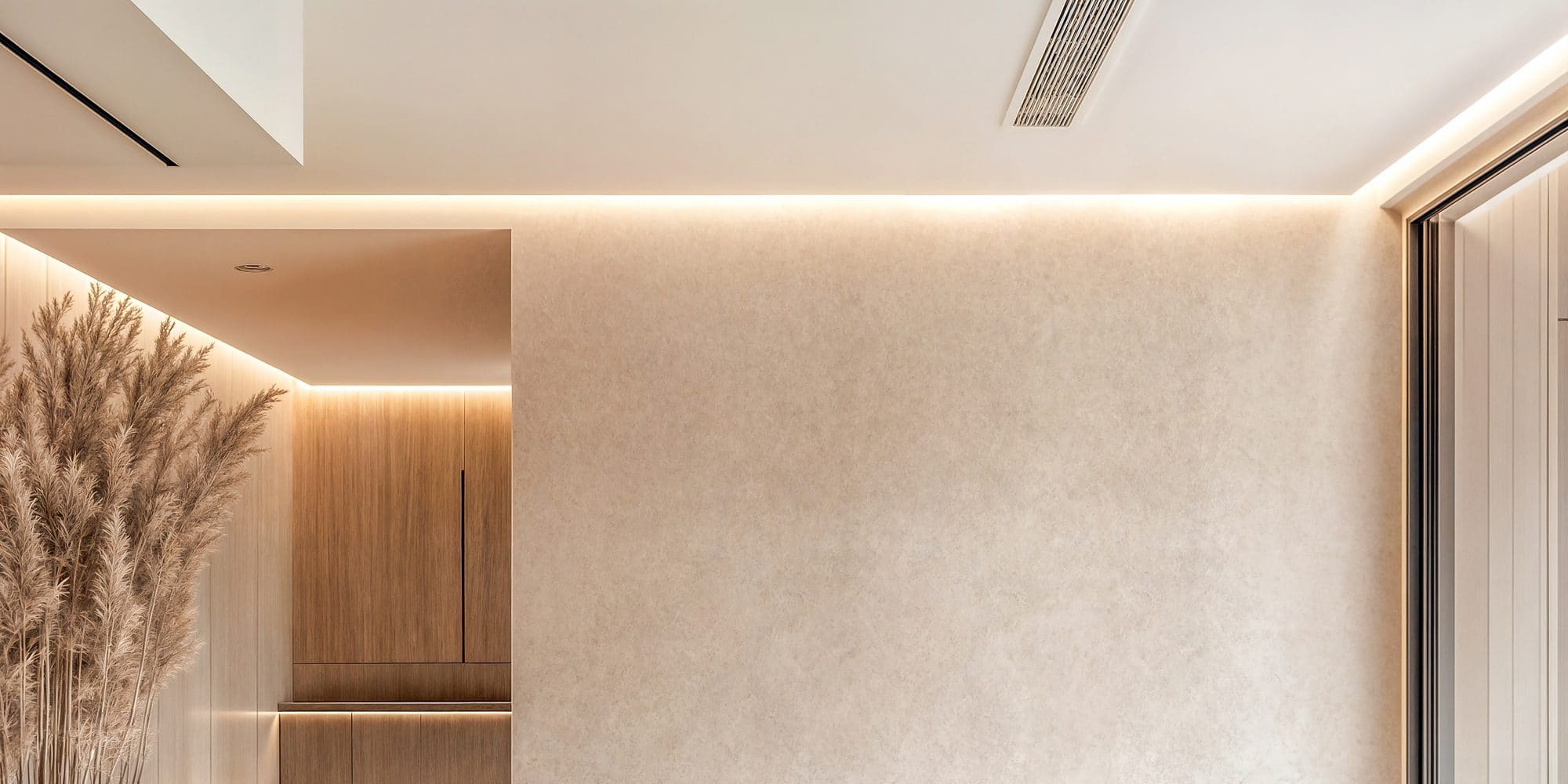
    A large window in the same plane as the wall, a wall light close by, a floor lamp right up against it. The light travels across the surface instead of striking it head-on, so it picks out every bit of relief: a textured effect comes alive and you can see the hand that made it. It is the best light for a filled decorative finish, and the worst for a badly done smooth one.

  2. Head-on lightLight that faces the wall, from the window opposite

    It flattens. With the light coming straight at it, the relief all but disappears and what is left is colour and sheen. A textured finish on that wall looks like a more expensive version of ordinary paint, and there the one that shines is the other kind of decorative finish: the one that plays with polish and reflection, not with grain.

  3. Night-time lightThe light almost nobody checks before deciding

    A living room is looked at in daylight when the finish is chosen, and lived in at night under warm, pooled light. That light is raking again — it comes from lamps, not from the whole ceiling — and it lifts earthy tones and dulls cool ones. A finish chosen at midday can be a different finish at ten at night. That is why a sample has to be seen on the wall at both times.

Hence the practical rule behind all of these pages: first you decide on the wall, then on the finish. Do it the other way round and you only get it right by luck.

Plain talking

What to bear in mind before having a decorative finish applied

The sample, on your wall

Not in a catalogue, not in a photo, not on a card you look at in your hand. A sample patch made with the real material, on the wall where it is going, and looked at at different times of day. It is the only honest way to decide on a finish, because it is the only one that shows how it behaves in the light of that room. Anyone who asks you to choose without it is asking for a leap of faith.

One wall, not four

A decorative finish works by contrast: it stands out because what surrounds it is plain. Wrapping a whole room in it usually achieves the opposite — it becomes tiring and makes the space feel smaller — and it multiplies the cost by four while taking away from the effect. The right decision is nearly always a single wall: the one behind the headboard, the one behind the television, the one in the hall that you see when you open the door.

It cannot be touched up like paint

A knock on a painted wall is fixed with a dab of paint from the same tin. Not on a decorative finish: it was built up by crossing layers, and a patch always shows, even if the colour is identical. What gets redone is the whole wall, from corner to corner. Worth knowing beforehand, especially if it is going in a corridor or at hand height.

Questions

What we are asked most about decorative finishes

Can a decorative finish be applied over gotelé?

Not directly. All of these finishes need a smooth wall: the bumps of gotelé — the spattered texture found on so many Spanish walls — would show through the layers and, with a sheen, twice as much. First the wall is put right and then it is decorated; they are also two jobs with different criteria, and it is best not to mix them up in your head.

How gotelé is removed and the wall skimmed

Can it be cleaned? And in a house with children?

It depends on the finish and, above all, on whether it has a sealing coat. A polished, waxed plaster takes a damp cloth without any problem; a filled effect with an open pore holds on to dust and does not like being rubbed. In busy areas or at hand height, the sensible thing is to choose a sealed finish or simply pick another wall: against everyday wear and tear, no decorative finish wins.

What if I get tired of it? Can it be undone?

Yes, but it is not just a case of painting over it. Depending on the finish, the relief or the sheen has to be sanded back, then sealed with a primer that grips that surface, and only then painted. It is a job, not an afternoon. Worth bearing in mind when choosing where to put it: on a single wall it can be reversed without drama; throughout the house it is a major job.

Is it suitable for a bathroom or a kitchen?

In a bathroom you need to be careful. Steam condenses on the wall and some finishes absorb it; the ones that hold up well are those sealed with wax or a specific sealer, and even then away from the shower. In a kitchen the enemy is not water but grease, which sticks in the pores and will not come out. In both, the answer is usually a wall away from the source, not the one right next to it.

Why does it take longer than painting?

Because the time does not go on applying it, it goes on waiting. Between one layer and the next the material has to dry and, depending on which it is, cure; and the final polishing or waxing can only be done when the layer underneath is ready. Rushing that is exactly what produces finishes that look bad a year later.

How much does a decorative finish cost?

It varies a lot from one effect to another, and within the same effect it varies with the state of the wall to begin with, because the skimming beforehand goes in the same quote. What we do not do is give a price per m² over the phone for work that is charged by hours of skilled labour: we see the wall, agree the finish with a sample and fix the price in writing.

Show us the wall and the light it gets

One photo of the wall and another from the doorway of the room, so we can see where the light comes in. With that we can tell you which finishes would work there and which would fall flat, and the next step is to see a sample on that same wall.

CallQuote