Blog · Facades and restoration
House exterior colours: what the bylaws require, what the sun does and the ochres of Málaga
Before the colour chart come the bylaw and the sun: what each town sets, what sunlight does to a dark or strong colour, and the ochres and red earths that painted Málaga before white.
7 min read
Anyone looking for colours for the outside of their house usually finds manufacturers’ colour charts and photos of pretty houses. On this coast, before you open any chart, three questions matter more than taste: what the town will let you use, what the sun will do to that colour and what colours this part of Spain has really had.
All three have answers in documents you can read, and we have read them: two bylaws, a study of the colours of central Málaga, the Spanish Building Code and a manufacturer’s brochure on why colour fades.
First, what the town requires
In some places the colour is not yours to choose. The Mijas conservation bylaw says so in article 28: “In the town centre of Mijas Pueblo, white is set as the colour for whitewashing facades”. In La Cala it asks for white preferably, and across the whole municipality it bans leaving a facade “cement-coloured or unrendered”. What that means when painting is on our Mijas page.
Torremolinos approved its urban aesthetics bylaw on 24 September 2026, and the council summed up what it asks of colour: facades must have a “harmonious colour scheme consistent with the immediate urban surroundings”, and “the use of fluorescent, neon, metallic or highly saturated colours on facades is prohibited”. In its areas of special tourist and historic interest (La Carihuela, the old town, La Nogalera and El Bajondillo, according to that announcement) only colours from a range set by the council itself are allowed. It does not force anyone to change what was legally done before, but it does require adapting when you apply for a licence or file a declaración responsable for work on the exterior. We explain it in detail on the Torremolinos page.
And in a block of flats, the comunidad (the community of owners) comes first: the facade colour belongs to everyone and is decided at the owners’ meeting.
Andalusia was not always white: the colours of Málaga
The whitewashed village is the image everyone has, and in places like Mijas it is the rule. But central Málaga tells another story. In 1997 the council received its Colour Plan, for which the 1,500 facades of the old town were surveyed with samples and analysis of their layers of paint. Its director summed it up in the bulletin of the Andalusian Institute of Historical Heritage: “Beneath the cliché of traditional Andalusian whitewash, walls painted in fresco with very colourful motifs came to light”.
The plan also rescued a set of the city’s Ordinances dated 1611 and drafted in 1556, which laid down even how buildings were painted. Exterior painters worked in fresco, with lime “well tempered”, and the pigments for facades were fixed: albayalde (ivory), açofaira (golden), almagra (ceramic red) and prieto (shadow). According to the same article, that palette carried on into later architecture, and “yellow, ochre and oxide tones are still the dominant ones in Málaga’s Colour Chart”. If your house is in the city, start with our Málaga page.
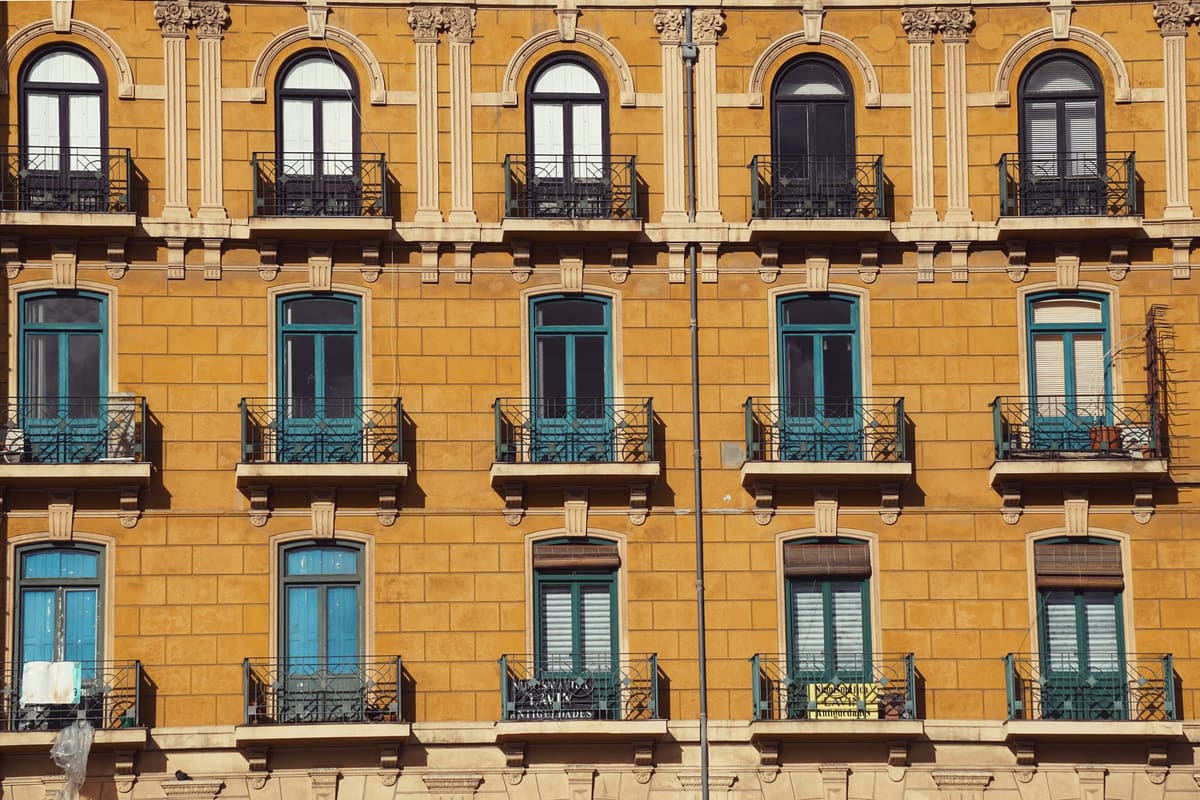
The same article warns of something that applies in any town: when a rule only says that colours will be “the traditional ones of the area”, the colour ends up being chosen on site, from a commercial chart. If your bylaw is worded like that, ask the council what it means before you buy the paint.
What the sun does to a dark colour
The Spanish Building Code has a word for this: absorptivity, the “fraction of the solar radiation incident on a surface that is absorbed by it”, which ranges from 0 to 1. A light colour sends back a good part of the light that reaches it; a dark one keeps more, and that energy is what heats the wall.
Same sun, two colours
The same sun on two colours. Both walls receive the same radiation; what changes is how much of it each one keeps.
The light one sends more back; the dark one keeps it: the Spanish Building Code calls absorptivity the fraction of solar radiation a surface absorbs, and that is what heats the wall.
And over the years, the strong colour fades: organic pigments break down under UV rays, and blues are among the most prone.
Here that matters more than elsewhere, because there is a lot of sun and, on a west-facing facade, some of the harshest of the day. Why orientation decides so much is on our facades page. And if the facade is insulated from the outside, the colour also has a limit with a figure, which we explain in SATE finishes.
Why strong colours fade first
The brochure of a mineral paint manufacturer explains it with two pieces. The first is the pigment: “Conventional paints often use organic pigments that are degraded by exposure to UV rays. After just a few years, the colours start to lose intensity and fade”. The second is the binder: when the organic resin breaks down in the sun it turns cloudy, the paint looks duller and chalking sets in: the pigment and fillers lose their grip and the rain washes them away.
To test it, a German institute left samples of several paints in a strong blue outdoors for eight years because, the brochure says, “blue pigments are especially prone to degradation”. It should be read for what it is: a manufacturer selling silicate paints with inorganic pigments, explaining why its own last longer. But the point holds for any paint: the stronger the colour, the more the pigment matters, and it is a question you can ask before buying. Silicate paint, what is more, only goes on mineral surfaces; its conditions are in how a facade is painted.
How to choose, in three steps
- Ask before you look at colours. At the council, whether there is a set colour, a range or banned colours; at the comunidad, if you live in a block of flats.
- Look at the orientation. On a west-facing side, a dark colour heats the wall more, and a strong one fades sooner.
- Ask about the paint, not just the colour. Which pigment and which binder it has, especially if the shade is strong. And try the colour on the wall itself, in the sun, before painting the whole thing.
Frequently asked questions
Which facade colour stays coolest?
Which facade colour stays coolest?
The light one. The Spanish Building Code calls absorptivity the share of solar radiation a surface absorbs, between 0 and 1: the darker the colour, the more it keeps and the hotter the wall gets. If the facade has external insulation, the render manufacturer also sets a limit on dark colours, which we explain in our page on SATE finishes.
Do I need permission to change the colour of my facade?
Do I need permission to change the colour of my facade?
It depends on the town and the building. In Torremolinos, the urban aesthetics bylaw applies when you apply for a licence or file a declaración responsable (a sworn notice of works) for work on the exterior, and in its areas of special interest the colour comes from a council range. In Mijas Pueblo the colour is already set: white. And in a block of flats, the facade colour is decided by the comunidad de propietarios (the community of owners).
What is the traditional colour of village houses around Málaga?
What is the traditional colour of village houses around Málaga?
It depends on the village, and it is not always white. In Mijas Pueblo the bylaw sets white. But in central Málaga, the survey of its facades for the 1997 Colour Plan found, contrary to the cliché of whitewash, walls painted in fresco with plenty of colour, and yellows, ochres and oxides are the dominant tones on its colour chart.
Why has the colour of my facade faded?
Why has the colour of my facade faded?
Because the sun breaks down what gives it colour or what holds it in place. According to the mineral paint manufacturer whose brochure we read, many conventional paints contain organic pigments that UV rays degrade, and their resin turns cloudy and lets the rain wash the pigment away. Strong colours, and blues above all, show it most.
Can I paint my facade a strong blue or red?
Can I paint my facade a strong blue or red?
In Torremolinos, if it is highly saturated, no: the bylaw bans it on facades. Where it is allowed, bear in mind it is the kind of colour that loses intensity first in the sun, and it is worth asking which pigment the paint contains before choosing it.
Sources
- Ayuntamiento de Mijas, Ordenanza urbanística sobre conservación, rehabilitación y estado ruinoso de las edificaciones (art. 28).
- Ayuntamiento de Torremolinos, «Todos los grupos políticos respaldan con su voto la aprobación de la ordenanza que regula la estética urbana de Torremolinos» (24 September 2026).
- Joan Casadevall Serra, «Planes del color de centros históricos: el ejemplo de Málaga», PH Boletín del Instituto Andaluz del Patrimonio Histórico, no. 67 (August 2008).
- KEIM, «Colores para siempre. Estabilidad de color en pinturas de fachada» (edition 08/2026).
- Ministerio de Vivienda y Agenda Urbana, Código Técnico de la Edificación, Documento Básico HE Ahorro de energía (annex A, terminology).
Quotations from Spanish-language documents are our own translations.