Skip to content
Pintoresdel Sur
Facades

Facade painting for the coastal climate

We paint and repair the facades of houses and apartment buildings across the province of Málaga. A facade here does not age like one inland: the breeze brings salt, the levante (the easterly wind) drives the rain in sideways and the afternoon sun beats down on it. This page explains what you have in front of you and what is happening to it, so that you can make sense of the quote you are given.

Start here

What your facade is made of

It is the first thing anyone who knows the trade looks at, because everything else follows from it: which products it takes, what cleaning it can stand and whether it needs repairs first. You can identify it from the pavement, in a minute and without tools.

Single-coat render (monocapa)

The norm on new buildings since the 1990s

How to recognise it
An even, scraped grain, and fine grooves running vertically down the facade and around the windows. Those grooves are panel joints, put there on purpose, and they are the first place to look: they are where single-coat render shows that it has moved.
What it means
It is coloured right through the mix, so it was never painted to begin with. It can be painted, but first you need to decide whether that makes sense: once painted, it stops being single-coat render as far as maintenance goes and has to be repainted like any other facade.

Painted render

What you find on almost everything older

How to recognise it
You can see the paint film: scrape a hidden spot with a coin and a flake of colour will come off with the grey mortar underneath. If running your hand over it leaves coloured dust on your palm, the sun has turned the paint to powder and it no longer holds anything.
What it means
What decides the job is not the old colour but how much of it is still stuck to the wall. A sound film is washed and repainted; one that peels off in strips has to be removed, and that is the part that varies most from one facade to the next.

Exposed facing brick

Entrances, plinths and 1980s villas

How to recognise it
The brick is on show as it is, with its mortar joints. If there are white marks that come and go depending on the rain, that is efflorescence: salts that the water carries out from inside and that crystallise on the surface.
What it means
The default answer is not to paint it. Sound facing brick is cleaned and treated with a clear water repellent, which stops water getting in without sealing the pores. Painting it is an aesthetic decision with no easy way back.

External wall insulation (SATE)

Recent refurbishments

How to recognise it
Give it a gentle knock with your knuckles: it sounds hollow and soft, not like a wall. The finish is a few millimetres of mortar over an insulation board.
What it means
It does not take what a solid wall takes: no aggressive scraping, no high-pressure washing and not just any paint. It is repainted with a product compatible with its finishing coat, and that is what keeps the system watertight.
What happens here and not in Madrid

Three things are eating away at your facade

And all three are at work at the same time, each in its own way. Knowing which one is hitting yours hardest explains why one side of the building is spotless and the side next to it is not.

  1. SaltAnd why a facade blisters when it has not even rained

    The sea breeze carries chlorides inland and leaves them on the facade. They are hygroscopic salts: above a certain level of humidity they draw water out of the air by themselves, with no need for rain. If that moisture is trapped under a paint that does not breathe well, it pushes from inside and lifts the paint in blisters. That is why a facade two hundred metres from the water ages differently from the same facade two kilometres inland, and why on the seafront the choice of paint matters more than the colour.

  2. The levanteRain that gets in where it should not

    When the levante, the easterly wind, blows hard, the rain does not fall: it comes in sideways and strikes the wall horizontally. A crack that would never have caused trouble in vertical rain becomes a direct way in for water, and so do the joint between a window and the wall or an open joint. That is why, on the same building, the side facing the levante deteriorates before the others, and why looking only at the main facade — usually the one on the street — misses precisely the one in the worst state.

  3. The west-facing sideThe afternoon sun, which is what fades the colour

    A west-facing wall gets the sun in the hottest hours, so it takes the highest radiation and surface temperature of the day. That does two things: it fades the pigment, especially in saturated colours, and it puts the coating through a daily cycle of expansion and contraction that eventually wears it out. A dark colour gets hotter than a light one under the same sun, and on a west-facing facade that difference is paid for in years of life of the finish.

Which leads to a piece of advice that costs nothing: when you ask for a quote, make sure whoever comes walks all the way round the building. The facade you see from the street is hardly ever the one in the worst state.

Plain talking

What to bear in mind before painting your facade

How the wall is reached

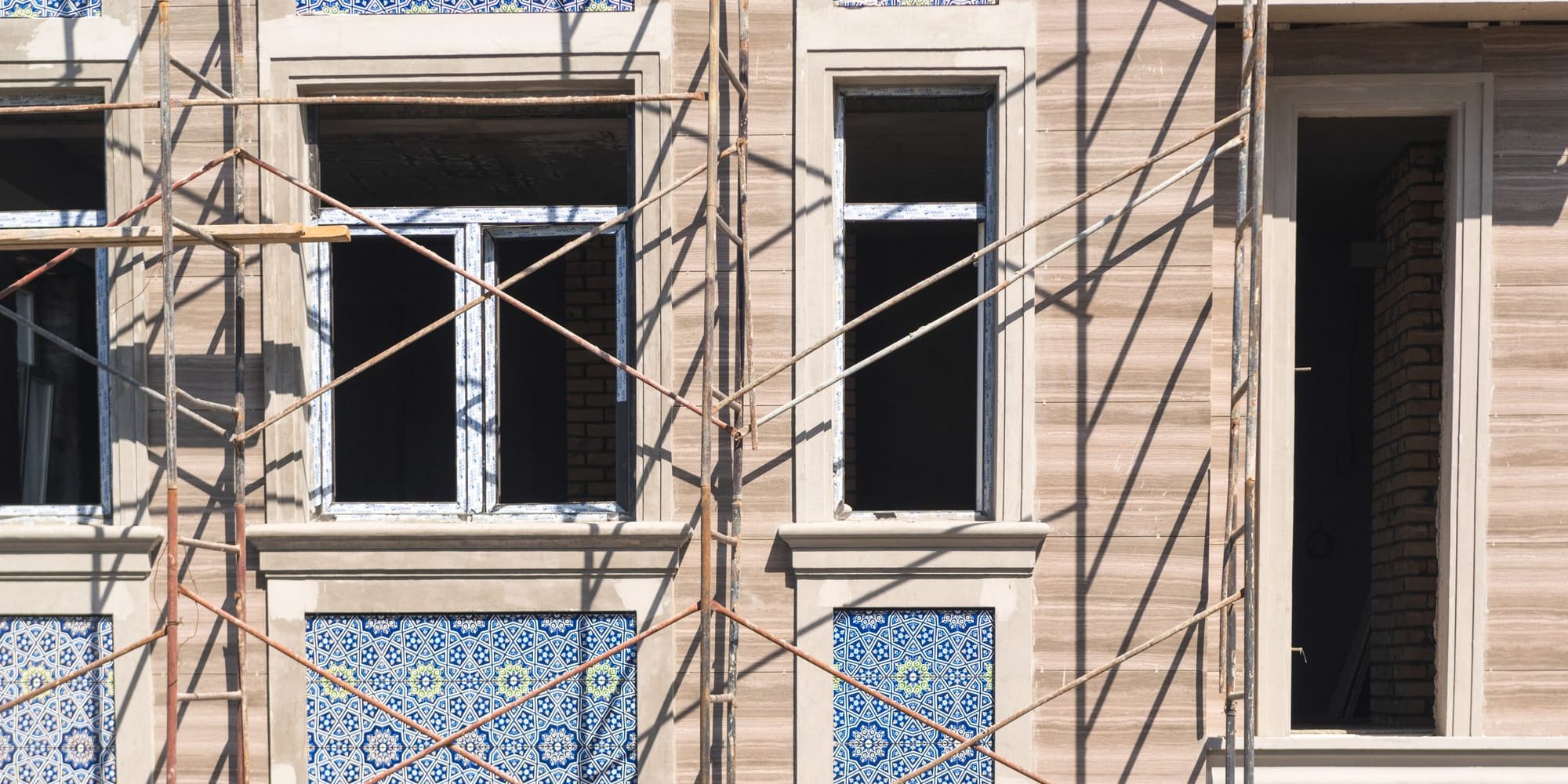
On a facade, the means of getting up there is a building decision in its own right, not a detail. Scaffolding, a cradle suspended from the roof or rope access: each one needs certain conditions — height, somewhere to stand it or anchor it and, if it takes up pavement or road, the relevant permission from the town hall. It is worth settling at the start, because it shapes the whole schedule.

When it can be painted

The data sheets of exterior coatings set a temperature range and a maximum relative humidity, and they require a dry surface and no rain while the film forms. That trims the calendar at both ends: in summer the sunny side goes above the maximum application temperature and the product dries before it can be spread, and in winter the wall cools overnight below the dew point and starts the day covered in condensation, which stops the paint from gripping. That is why the good window is spring and autumn, and why rainy levante days are ruled out whatever the month.

Who decides

A house is not the same as an apartment building. In a detached house, you decide and the work starts whenever you like. In a building run by a comunidad de propietarios (the community of owners), the work is approved at the owners’ meeting, and what is contracted is not only the facade: it is also the order it is done in, how residents live with it and who answers to the neighbours. It is worth knowing which of the two cases you are in before asking for anything.

Questions

What we are asked most about facades

How often does a facade on the coast need painting?

There is no figure that holds for every facade, and anyone who gives you one without seeing it is making it up. What sets the timing is the orientation, the distance from the sea and the product used last time: the same paint lasts considerably less on a west-facing side on the seafront than on a sheltered facade in the shade. The reliable sign is not the calendar but the facade itself: when the colour goes, a fine dust comes off on your hand or the first flakes appear, it is already asking for it.

Can a facade be painted in stages, or does it have to be done all at once?

Technically it can, and communities on a tight budget do it. The problem is that it will show: a freshly painted facade next to one with years of sun on it will not match even with the same tin of paint, because what has changed is not the colour but the sheen and the texture. If it has to be phased, the sensible thing is to divide it by whole planes — an entire side, not half of one — and accept the step where the eye is least likely to look for it.

Do repairs have to come first, or will the paint cover them?

Paint does not cover anything structural: it stretches over the crack and within a few months the crack shows through again. Painting a surface that is still moving is paying up front to end up back where you started. The right order is the other way round: first find out why it opened, repair it, and then paint what is already stable.

Can I choose any colour I like?

On a house, yes, with two warnings: very saturated and dark shades lose their colour sooner in the afternoon sun from the west, and the darker the colour, the hotter the facade gets. In a community of owners, the colour is also decided at the owners’ meeting, and in some areas there may be municipal conditions on the external appearance; that is checked before buying paint, not after.

What is the difference between painting a facade and restoring it?

Painting is renewing the finish of a facade that is sound. Restoring is working on what lies underneath — repairing the substrate, dealing with water getting in, sometimes insulating it — and painting at the end as the last step. You can tell them apart by looking: if what is failing is the colour, it is a paint job; if there are cracks that keep coming back, areas that sound hollow when tapped or damp patches that reappear, painting alone would be the worse investment of the two.

How much does it cost to paint a facade?

It depends on three things, and none of them can be seen over the phone: the real square metres, how they are reached and the state of the surface. In fact the access equipment can weigh as much as the paint. That is why we do not give a price per m² blind: we see the facade, measure it and give you a fixed price in writing.

Tell us what kind of facade you have

One photo from the pavement opposite, so we can see the whole facade and its height, and another close up of the area that looks worst. With that we can tell you what is going on and what it would need, and arrange a visit to measure up.

CallQuote