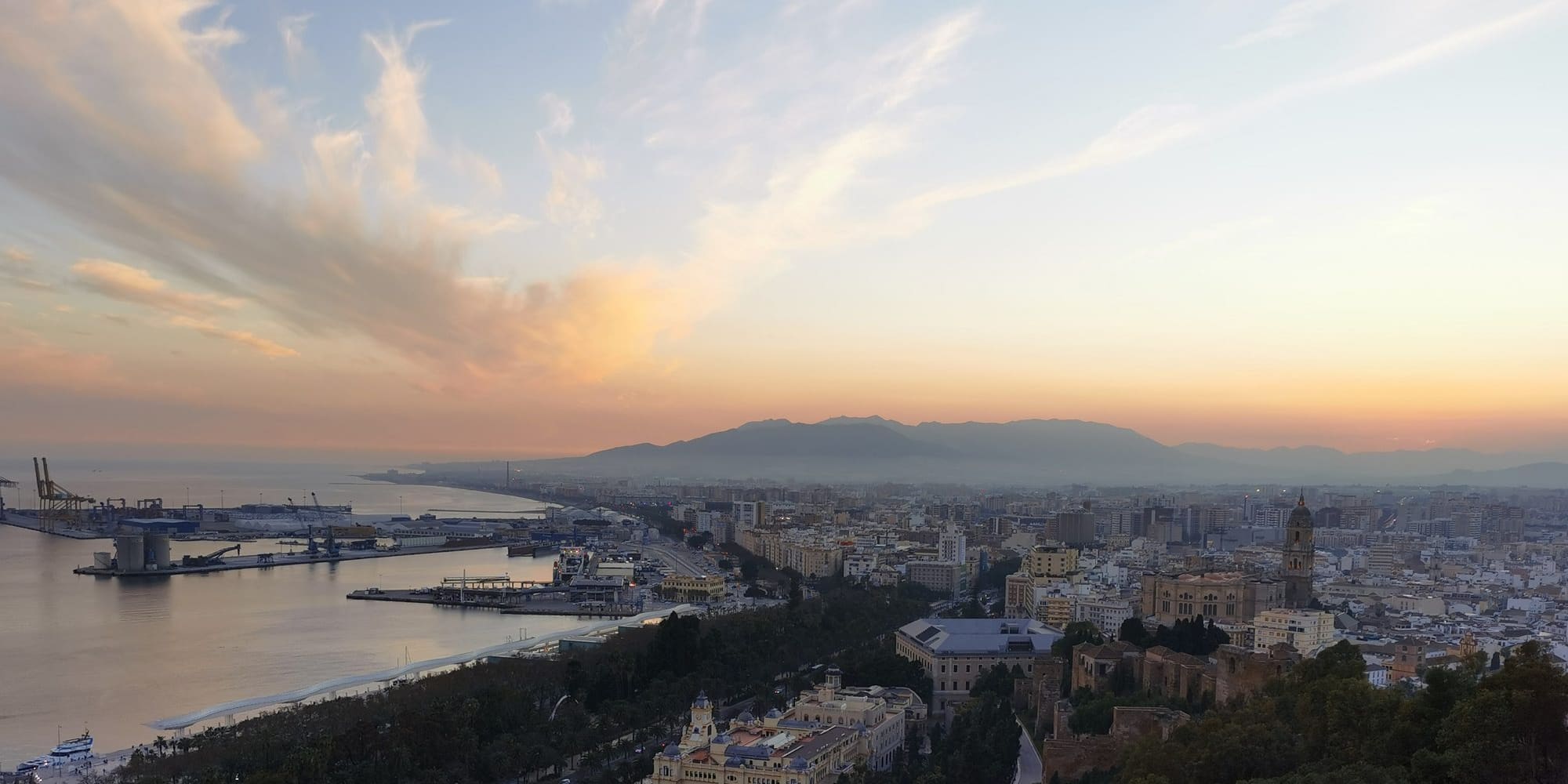
Painters in Málaga: flats, apartment buildings and facades in the city
A painting and decorating company working across the municipality of Málaga: removing gotelé (the stippled, textured wall finish) and painting flats, entrance halls and stairwells for comunidades de propietarios (communities of owners), facades and decorative finishes. And two things that weigh more in Málaga city than along the rest of the coast: this year’s ITE campaign (the Inspección Técnica de Edificios, the compulsory building inspection) and the rules for the historic centre.
We work in every neighbourhood: Teatinos, Carretera de Cádiz, El Palo, Pedregalejo, Ciudad Jardín, Churriana and the historic centre.
The job, and the page that explains it
Each service has its own page, with what you need to know before asking for a quote. Here is which one to look at, depending on what you want done.
Gotelé and skimming
For a flat with gotelé that you want smooth before it is painted.
Painting a flat or house
For painting a whole home, empty or with the family living in it.
Facades
For the facade of a house or a building, starting with knowing what it is made of.
Communities of owners
For the entrance hall, stairwell and garage of a block, and what has to be approved at the owners’ meeting.
External wall insulation
For insulating the building from the outside and painting it at the same time.
Decorative painting
For a polished plaster, an effect or a wall that has to stand out.
The 2026 ITE campaign
In the municipality of Málaga, every listed building or building more than fifty years old has to pass the technical inspection. And every year the Gerencia de Urbanismo (the city’s planning department) publishes whose turn it is.
In the 2026 campaign, buildings constructed in 1975, according to the year recorded in the Catastro (the Spanish property register), are required to submit their first report, and those that submitted it for the first time in 2016 are required to renew it. The deadline is 31 January 2027.
The facade is at the heart of the inspection: the inspector checks the safety of the external facades, the internal ones and the party walls, especially anything that could come away and fall onto the pavement, such as slab edges or cornices, and the watertightness of roofs, roof terraces and external doors and windows.
If the report is unfavourable, the works in it become compulsory and the licence has to be applied for no later than three months after submitting it. The bylaw, including what it costs not to submit the report, is covered in the ITE bylaw, explained.
How the facade work is organised in an apartment building: facade restoration.
Painting within the PEPRI Centro
Central Málaga has its own special plan, the PEPRI Centro (Plan Especial de Protección y Reforma Interior, the special protection plan for the historic centre), approved in 1990 with a catalogue of protected buildings from 1992. Its area includes the Conjunto Histórico (historic quarter) declared a Bien de Interés Cultural (Asset of Cultural Interest) in 2012. In 2018 the Gerencia published a guide for the facades of shops and commercial premises, and several of its rules bear directly on painting. The plan was already under review at the time: before any specific job, check with Urbanismo what applies on that day.
Four rules for the front of a shop or business
They apply to commercial premises in listed buildings or within the PEPRI. The quotations are from the municipal guide; quotations from Spanish-language documents are our own translations.
The ground floor follows the floors aboveMaterial, finish and colour
The guide puts it like this: “The wall finishes on the ground floor must be continuous with those of the upper floors in terms of their material, finish and colour.” Painting a shop front in a colour of its own, different from the building, is exactly what the plan wants to undo.
The original plinth is not painted overIt is restored in its own material
Original plinths are recovered and replaced “using the same material as the existing one”. Among its examples of what is wrong, the guide shows a stone plinth whose finish “is altered by painting part of the piece”.
Exposed brick stays exposedPainting it alters the original design
Another of the cases flagged as incorrect: a ground floor of shops where “the original exposed-brick finish is not respected, as it has been painted”. If the facade is brick, the job is to clean and protect it, not to cover it.
No cladding or add-onsWhat is expressly prohibited
The guide prohibits “partial works that alter the facades with cladding panels, linings and other additions foreign to the architecture of the building”, and asks for any coverings that are not original to be removed. Mouldings, friezes and corbels are kept or replaced like for like.
The guide adds that the City Council will refuse applications that do not respect the materials, the techniques and the townscape. In the centre, colour is decided with the regulations in front of you.
What to bear in mind before painting in Málaga
Your building’s year, in the Catastro
It is the reference the Gerencia uses to know whether a building is due its ITE. Before asking for a quote for a comunidad’s facade, it is worth checking: if the building is from 1975, this year’s inspection comes first and the painting afterwards.
In the centre, the paperwork before the colour
Within the area covered by the PEPRI, the municipal guide makes it clear that the licence to refit commercial premises depends on respecting the original composition and colour scheme. If the building is in the historic centre, check with Urbanismo which procedure applies before choosing anything.
A written, itemised quote
For a flat, room by room; for a block, area by area; for a facade with an ITE, following the items in the report. It is what lets you compare offers, and with an unfavourable ITE it is also what is submitted together with the report.
Common questions about painting in Málaga city
Do you work all over Málaga city?
Do you work all over Málaga city?
Yes, across the whole municipality: the centre, Teatinos, Churriana, the Carretera de Cádiz area, Ciudad Jardín, Pedregalejo or El Palo. Tell us where the home or the building is and what you want done, and we will arrange to come and see it.
Is my building due its ITE this year?
Is my building due its ITE this year?
In the 2026 campaign, buildings constructed in 1975, according to the year shown in the Catastro, have to submit their first report, and those that submitted it for the first time in 2016 have to renew it. The deadline is 31 January 2027. The Gerencia publishes the list of buildings that are required to do so on its website.
What happens if the ITE is unfavourable?
What happens if the ITE is unfavourable?
The works the report points out become compulsory, and a licence has to be applied for within a maximum of three months of submitting it. When they start and finish is set by the licence itself. Painting the facade is usually the last step of those works, not the first.
Can I paint the front of my shop in the centre any colour I like?
Can I paint the front of my shop in the centre any colour I like?
If the premises are within the PEPRI, no. The municipal guide asks for the ground floor to follow the upper floors in material, finish and colour, for original plinths to be restored in their own material and for exposed brick not to be painted. The prudent thing is to check the procedure with Urbanismo before commissioning anything.
How much does it cost to paint a flat in Málaga?
How much does it cost to paint a flat in Málaga?
We need to see it first: the price depends on the square metres of wall, the condition of the walls and the paint for each room. What makes a flat more expensive, and how to read a quote, is on the page about the cost of painting a flat.
For the price of a home: how much it costs to paint a flat, and what it depends on.
What needs painting in Málaga?
Tell us the neighbourhood, whether it is a flat, an apartment building or a facade, and whether there is an ITE involved. With that we arrange to come and see it and give you a written quote.