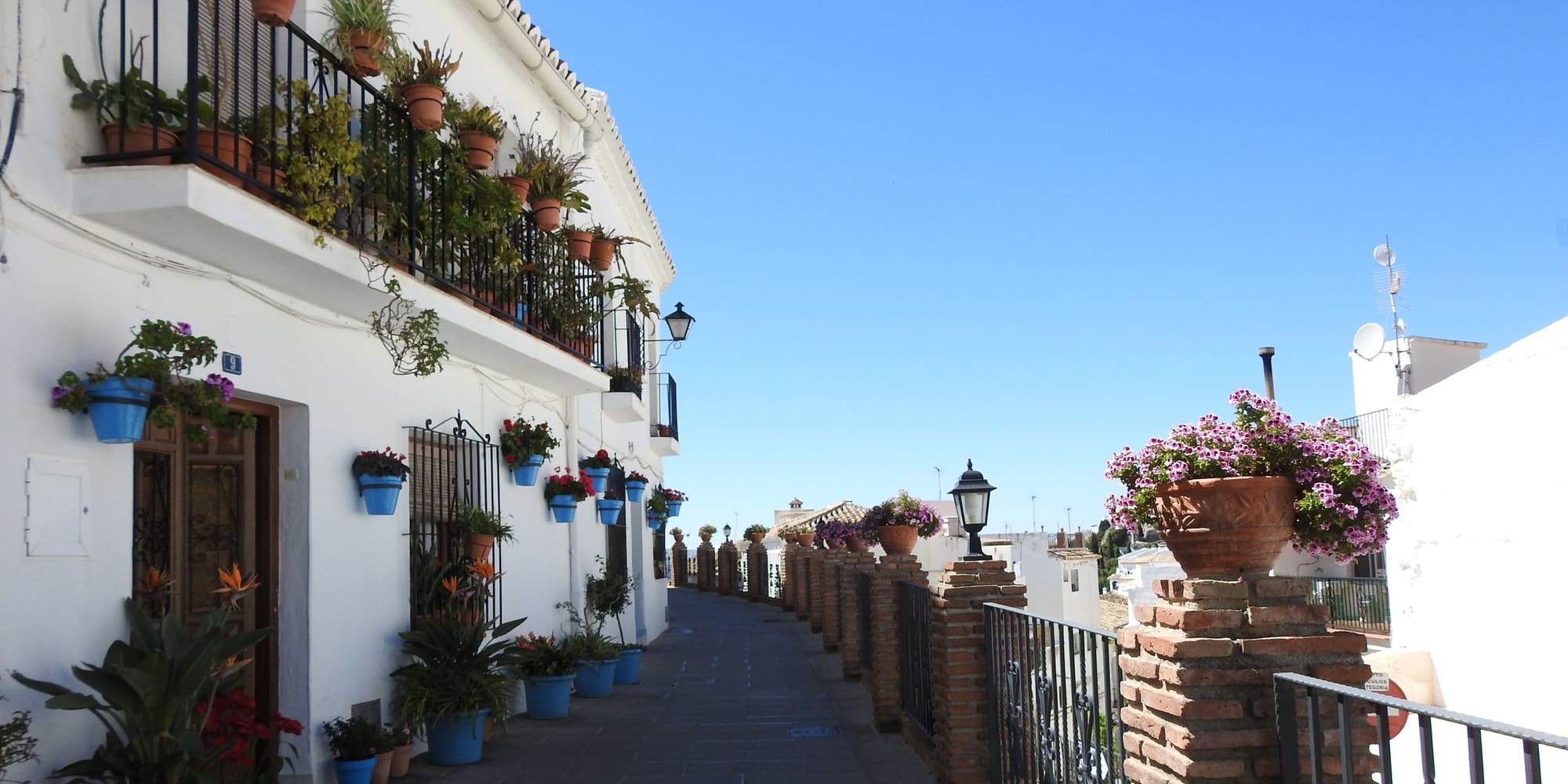
Painters in Estepona: from the limewashed house to the inspected block
Interior, facade and communal-area painting across the municipality of Estepona. And two local facts that decide how a facade is prepared before the tin is opened: a building inspection that kicks in when a building turns 30, and an old town where limewash has hidden paintings for centuries that the Town Hall is now recovering.
We cover the whole municipality: El Centro, Cancelada, La Lobilla, Seghers, the old town and the urbanisations.
Every job has its own page
What applies along the whole coast is explained on each service page. Pick the one closest to the job you have in hand.
Facades
For the facade of your house or your block, starting with what it is rendered in.
Facade repair
For cracks and anything coming loose, which is what raises a facade’s grade in the inspection report.
Facade restoration
For the whole job on a building after the inspection, step by step.
Communities of owners
For entrance halls, stairwells and garages in an urbanisation or a block, and what the owners’ meeting has to vote on.
Painting a flat or house
For the inside of a house or a flat, from a single room to all of them.
Gotelé and skimming
To get gotelé walls smooth before they are painted.
In Estepona, the ITE starts at 30 years
The ITE (Inspección Técnica de Edificios, the periodic building inspection) is set by the town’s own by-law, published in the provincial gazette on 30 July 2007. It dates from 2007, so before counting deadlines for a particular building it is worth checking with the Town Hall that it is still the version in force.
Every building listed or protected by the planning rules has to pass it, and so does every building more than 30 years old, whatever its use and whoever owns it. The first report is due within the year after the building reaches that age, and it is renewed every ten years.
The architect or surveyor who signs it checks, among other things, the condition of the outer and inner facades and the party walls, “and in particular any other element that could pose a danger to the public highway or interior areas”, such as parapets, terraces, panels, canopies and balconies.
And the report has consequences for the job: when it says works are needed, the by-law does not allow any building licence to be granted unless it includes at least the works needed to put right the serious defects. What the report asks for comes first; the painting goes with it or after it.
The facade, graded from 0 to 3
The by-law’s report form scores facade damage on a four-step scale. In quotation marks, what the form says; underneath, what it means for whoever is going to paint it.
Grade 0: “in good condition, or with minimal defects that do not require repair works”
Here painting is maintenance: clean, make good the little there is and repaint.
Grade 1: “minor damage to the finishes or decorative elements that only needs repairs to them and poses no risk of anything falling”
This is a decorator’s territory: repair the render or coating where it has failed, then paint, without touching what lies beneath.
Grade 2: “significant defects that require work on the substrate or on projecting elements, with no risk of anything falling”
The substrate or the projections, such as balconies and cornices, are repaired before any paint. Painting over them would only hide the problem for a season.
Grade 3: “damage to any element of the facades or the building that poses a risk of falling onto public spaces and requires repair works and immediate safety measures”
The safety of the street comes first. The form itself lists the measures: propping lintels, clearing loose material from the facade, a stabilising scaffold and bracing openings. Paint comes last.
How to tell a crack that needs watching from one that is only in the render: facade repair.
What may lie beneath the limewash
In calle Mondéjar, the Town Hall recovered an 18th-century Baroque mural on the facade of a historic house: framed windows, caryatids and scrolls in yellows and oranges, painted in trompe-l’œil, the resort of owners who wanted architecture on their facade and could not afford to build it.
According to the municipal archaeologist, these murals were covered with limewash for public-health reasons: the authorities of the time ordered facades to be whitewashed to stop epidemics such as typhus or yellow fever from spreading.
In plaza de Las Flores another one, from the 19th century, came to light during the renovation of a privately owned building that served as the town hall during the Liberal Triennium (1820–1823). To recover it, the layers hiding the original painting were removed first, the gaps were filled and treatments were injected to consolidate the mortar and the other materials of the facade.
What this changes on a job: on an old house in the centre, the limewash is not stripped blindly. If colours or drawings show through while the facade is being prepared, work stops and the Town Hall is told. It has said it will keep working with owners if other paintings like these appear in the historic houses, and it also mentions plaza de Manuel Alcántara.
There are murals outside the old town too: the Ruta de Murales Artísticos, the town’s mural route, numbered 62 paintings on building facades across the town when the Town Hall announced its plan to restore them. In the first phase, five of them are being restored by their own artists, with cleaning, crack treatment, consolidation of loose areas, colour reintegration and a final protective coat. If your building’s facade carries one, the painting work is planned around it and the Town Hall is consulted first.
What to bear in mind before painting in Estepona
The age of the building, on paper
For the by-law it counts from when construction was completed, and it is proved with the certificate of completion (certificado final de obras), the occupancy licence or, failing that, the building licence. With that date in hand you know whether, for a block, the inspection has to come before the facade.
In an old house, look before you scrape
In the old town, the limewash on a facade may be hiding a painting two centuries old. If colours or drawings appear while the wall is being prepared, work stops and the Town Hall is told; it works with owners to recover them.
A quote that follows the report
If the building has an ITE report calling for works, the quote is set out with its items and in its order of priority. That way offers can be compared like for like, and it is the same list the licence will have to cover.
Common questions about painting in Estepona
Do you work all over Estepona?
Do you work all over Estepona?
Yes: from the old town and El Centro to Cancelada, La Lobilla, Seghers and the urbanisations across the rest of the municipality. Give us the street or the urbanisation and what needs painting, and we will come and have a look.
From what age does a building in Estepona need the ITE?
From what age does a building in Estepona need the ITE?
The 2007 by-law applies to listed or protected buildings and to any building more than 30 years old. The first report is due within the year after it reaches that age, and it is renewed every ten years. Before counting deadlines for a particular building, check with the Town Hall that this by-law is still the one in force.
And if it is not submitted?
And if it is not submitted?
Under the by-law, the Town Hall requires the owner to hand it in within no more than three months, with a warning that penalty proceedings will follow. On top of that, no municipal renovation grant is awarded until the obligation is met, and any building licence other than for minor works requires the report to have been submitted.
What should I do if an old painting appears under the limewash?
What should I do if an old painting appears under the limewash?
Stop and tell the Town Hall. That is how the murals in calle Mondéjar and plaza de Las Flores came to light, and the Town Hall has said it will keep working with owners if other paintings of that kind appear in the historic houses.
What does painting a facade in Estepona cost?
What does painting a facade in Estepona cost?
We need to see it: it depends on the square metres, on how we get up there and on the state of the wall, which is exactly what the ITE grades. Where each part of the price comes from is set out, item by item, on the facade cost-per-m² page.
For the price of a facade: what painting a facade costs per m² and what it depends on.
Where this comes from
Quotations from Spanish-language documents are our own translations.
- Ordenanza Reguladora de la Inspección Técnica de Edificios de Estepona (BOP de Málaga no. 147, 30 July 2007) — the town’s building inspection by-law
- Ayuntamiento de Estepona: «El Ayuntamiento recupera una pintura mural del siglo XVIII en la fachada de una casa histórica del casco antiguo» — the 18th-century mural
- Ayuntamiento de Estepona: «El Ayuntamiento recupera una pintura mural del siglo XIX que pertenecía a la antigua Casa Consistorial» — the 19th-century mural
- Ayuntamiento de Estepona: «El Ayuntamiento inicia un plan de restauración de la Ruta de Murales Artísticos para garantizar su conservación» — the mural route restoration plan
What needs painting in Estepona?
Let us know the neighbourhood, whether it is a home, an urbanisation or a block, and whether the building already has an inspection report. With that we will come and see it and send you the quote in writing.