Blog · Gotelé and skimming
Patching gotelé: why it hardly ever matches first time and how to get close
Covering a filled chase with gotelé is easy; making it disappear is harder: the mix, the nozzle, the pressure and the distance, and why the patch is tried out on a board and not on the wall.
6 min read
It happens in any small renovation: a chase is cut for a socket or a pipe, filled with plaster, and leaves a smooth strip in the middle of a gotelé wall. Making gotelé there is not much of a mystery. Making it disappear is, because the texture around it was made years ago, with another mix, another machine and another hand.
Here is why the first pass hardly ever matches and how you get close to the drop on the wall, with what Consumer magazine and the data sheets of two gotelé guns say.
Why the patch hardly ever matches first time
The method itself explains it. Consumer, in its guide to gotelé, asks for something that is impossible on a patch: “you need to prepare enough paint to finish the whole job. That way, you avoid differences in the preparation and in the finish”. When the wall was done, that mix was used up. The patch gets a different one, and “the consistency of the paint depends on the texture you want”: a little thicker or thinner, and the drop comes out different.
Then there is the machine. The grain is not decided by the mix alone: according to the same guide, “you should adjust the nozzle to get different grains or textures, vary the distance between the gun and the surface and set the air pressure”. That is three controls, and whoever did the wall set them their own way. That is why no two gotelés are the same, and why it helps to know first which one you have: the types of gotelé and how to recognise them.
There is an earlier question: what the wall’s gotelé is made of, distemper or plastic-based. If it is distemper, whatever goes on top sits on a layer that water softens, and that changes the plan. You find out with a damp sponge, as we explain on the gotelé and skimming page.
What moves the grain: nozzle, pressure, distance and load
The nozzle
The two gotelé guns whose data sheets we have read come with three nozzles, of 4, 6 and 8 mm. The jump between them is large. One of the sheets gives the flow of each, measured with water: 700 ml a minute with the 4 mm nozzle, 2,700 with the 6 and 4,300 with the 8. Going from the small one to the middle one means putting out almost four times as much. With a jump like that, it is hard to get it right by eye.
The pressure
Here the sources do not agree, and that already tells you something. Consumer says to set the air pressure “to at least 3 bar”. The sheet for one 5-litre gun gives a working pressure of 3.5 to 4 bar. The sheet for another gotelé gun, a maximum pressure of 1.75 bar. No single figure suits them all: the one that counts is on your gun’s sheet, and within it you adjust by watching the drop.
Distance and a steady hand
Consumer gives a reference: “stand about 30 cm from the wall and hold the gun upright”, and sweep from one side to the other, “never back and forth”. The sheet for one of the guns adds what matters most on a patch: “Keep the gun at a constant distance from the surface to ensure an even application”. Moving in closer to “fill” a gap changes the drop exactly where it will show most.
The load
On a patch the temptation is to keep going. Consumer warns what happens: you must avoid overloading the wall, or “instead of gotelé, you will get blobs that spoil the finish”. Better to fall short and make another pass than to overdo it.
The test board
With so many controls, the adjusting is not done on the wall. Both sources say so, each in its own way. Consumer, about the tyrolean machine: “The best option is to try various settings on a board until you find the one that best suits each case”. And the sheet for one of the guns: “Carry out tests on a small area or on scrap material to adjust the density and flow of the paint before applying it to the final surface”.
The patch and the test board
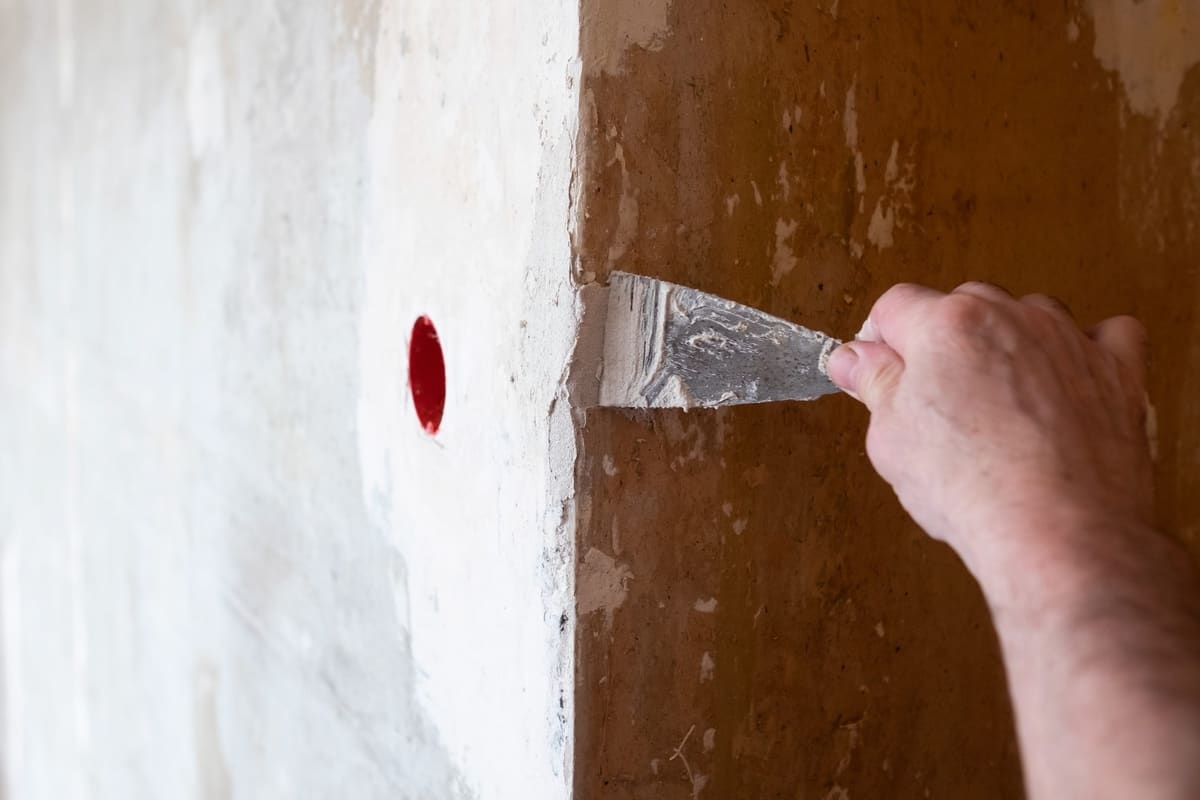
A filled chase in a gotelé wall. The new plaster is smooth; around it is a texture made years ago with another mix and another machine.
The first pass hardly ever matches: the mix is new, and the nozzle, the pressure and the distance change the size of the drop.
That is why it is tried on a board first: you test until you find the drop that looks like the wall, and only then spray the patch.
In practice: a board or an offcut of plasterboard next to the wall, one test strip for each setting and, once they are dry, a comparison with the real gotelé. Better with a torch held flat to the wall: seen head-on, any gotelé looks the same. Only when a strip blends in with the wall do you move on to the patch.
And before the drop, the patch needs its base. Consumer asks for it on any gotelé done with a gun: “you need to give a coat of smooth paint to act as a base”. On the new plaster of a chase, that coat comes before any drop.
Without a compressor: the tyrolean machine and the roller
Gotelé guns need a compressor. For a patch there is another tool that does not: the tyrolean machine, “a sheet-metal box, open on one side, with toothed rollers” that, turned by a crank, throw the mix at the wall. It has a lever to choose the grain size, and it is the machine Consumer recommends testing on a board. The mix is made by sprinkling the powder over a bucket of water until it is smooth, with no lumps, and it goes on in “two or three thin coats”.
A foam roller does not make gotelé, it makes a stipple: “the more times the roller is passed over the wall, the finer” it comes out. It works if the wall was already stippled; on a gotelé of round drops, the repair shows.
What finally hides it
Even if the drop matches, the patch still shows if only the strip is painted: new paint and old hardly ever have the same shade or the same sheen. So once the patch is dry, the whole wall is painted, corner to corner. If the wall’s gotelé is the flattened kind, the new drops are knocked down with the trowel before they dry, as was done with the rest.
And sometimes it is not worth it. When a renovation leaves the wall full of chases, matching each one costs more than making it smooth. Then it is time for gotelé removal and wall skimming. Send us a photo of the wall and we will tell you which works out better.
Frequently asked questions
Can you make gotelé by hand, without a compressor?
Can you make gotelé by hand, without a compressor?
Yes, with a tyrolean machine: a box with toothed rollers turned by a crank that throw the mix at the wall. It has a lever to choose the grain size. A foam roller also gives a texture, but it is a stipple, not a gotelé of round drops: it only matches if the wall was already like that.
What pressure do you set a gotelé gun to?
What pressure do you set a gotelé gun to?
Whatever your gun’s data sheet says. The sources do not agree: Consumer magazine talks about at least 3 bar, the sheet for one 5-litre gun gives a working pressure of 3.5 to 4 bar, and the sheet for another gotelé gun a maximum pressure of 1.75 bar. A figure taken from another machine is no use.
Which nozzle do you use for gotelé?
Which nozzle do you use for gotelé?
The one that gives the drop on your wall, and you find that out on a board. The guns we have read about come with three, of 4, 6 and 8 mm. The jump between them is large: according to one manufacturer’s sheet, with water the 6 mm nozzle puts out almost four times as much as the 4 mm one.
Why does the patch still show if the drop matches?
Why does the patch still show if the drop matches?
Because it still needs painting. New mix and old paint hardly ever have the same shade or the same sheen, and the strip shows even when the texture matches. So once the patch is dry, the whole wall is painted, corner to corner, not just the repair.
Sources
- EROSKI Consumer, «Decorar las paredes con la técnica del gotelé» (19 July 2005).
- Imcoinsa, data sheet for the 5-litre gotelé decoration gun.
- Cevik Pro, data sheet for the CA-1805 gravity-feed gotelé gun.
Quotations from Spanish-language documents are our own translations.