Blog · Insulation and energy efficiency
Thermal bridges: what they are, where they are in your home and what stops them
The places where a home loses extra heat, with the values from the Building Code atlas: a column with the insulation cut off against one with continuous insulation, and the roller-shutter box nobody looks at.
6 min read
If mould keeps coming back to the same corner of your home, or a corner feels cold to the touch in winter even with the heating on, you are very probably touching a thermal bridge. It is the technical name for a spot where a home loses extra heat, and the Spanish Building Code (the CTE, Código Técnico de la Edificación) devotes a whole document to them, with an atlas of the most common ones.
We have read it to explain, in everyday terms, what they are, where they are in a flat and what really stops them.
What a thermal bridge is
The Building Code defines it as the part of the building envelope (facades, roof, floors) “where there is a change in the uniformity of the construction”, through a change in thickness or material, because something more conductive passes through it, or because of its shape, and which leads to “a reduction in thermal resistance compared with the rest of the wall”. In short: heat gets out more easily there than through the rest of the wall.
And it is not only about energy. The supporting document puts it like this: thermal bridges are sensitive parts of buildings “because the risk of mould from surface condensation increases in them, due to the lower temperature of the inner surfaces (in winter conditions)”.
Where they are in a flat
The Code classifies them, and the list is almost a tour of the home:
- Those built into the facade: the columns set into it, the surround of the windows and the roller-shutter boxes.
- The junctions: the edge of each floor slab at the facade, and where the facade meets the roof or the ground floor.
- The corners of the facade, the balconies that project from it and the points where interior partitions meet the outside walls.
They are no small thing in area. An association of external insulation manufacturers reckons that, in a detached house, the weight of thermal bridges “can amount to 30% of the facade area”, and that in a block of flats that share “can be reduced by half”. It is the reckoning of those who sell the solution, so it is worth taking with caution, but it gives an idea of the order of magnitude.
How it is measured: watts per metre
A wall is measured per square metre; a thermal bridge, per metre of length. The supporting document uses a Greek letter, ψ (psi), which describes “the additional heat transfer” of the junction compared with the wall next to it. It is given in W/mK: the extra watts that escape for each metre of column or slab edge, for each degree of difference between inside and outside. The higher it is, the worse.
The document’s atlas works out those values for the most usual construction details, with 20 °C inside and 0 °C outside, and draws a conclusion that holds for all of them: “the most decisive factor in improving the performance of construction details is keeping the insulation of the walls continuous”.
The column and the insulation
A column in the facade, with the insulation cut off. The heat of the home takes the easy way out: the concrete of the column, where there is no insulation.
Inside, that spot stays cold. The Building Code atlas places condensation in the corners between the column and the wall, and in the middle of the column’s inner face.
With continuous insulation on the outside, the bridge all but disappears: for a 25 × 25 cm column, the atlas gives around 1 W/mK with the insulation cut off, and 0.00 to 0.02 with continuous insulation.
What the atlas says, piece by piece
The column
For a concrete column set into the facade, the atlas has two groups. If the insulation runs in front of the column without a break, the bridge “practically disappears”: 0.00 to 0.02 W/mK. If the insulation stops at the column, the value is “around 1” for a 25 × 25 cm column and rises with its size, up to 1.40 for a 35 × 35 one.
The slab edge
Every floor of the building crosses the facade with a concrete slab. When the insulation runs in front of that edge, the atlas says, “practically no thermal bridge occurs”. When it does not, the linear transmittance ranges from 0.70 to 1.07 W/mK depending on the thickness of the slab and the wall, and the condensation risk appears in the corners where slab and wall meet, which is where the wall meets the ceiling in each room.
The roller-shutter box
It is the one nobody looks at, and one of those that changes most. An insulated PVC or timber box stays below 0.13 W/mK. Uninsulated, between 0.92 and 1.04, like a column: its highly ventilated cavity “exposes its inner wall to outdoor conditions”. And if it is metal, between 1.41 and 1.52.
The window head, and a paradox
Around windows, what matters is that the insulation reaches the frame. When it does not, the atlas points out something hard to believe: at window heads, “as the thermal insulation of the wall increases, the thermal bridge effect becomes more acute”. The better the rest of the wall insulates, the more heat is diverted to the point that has been left unresolved. Insulating the wall more without dealing with the junctions moves the problem to the junctions.
How you notice it at home
On the inside, a thermal bridge is a surface colder than the rest of the wall. The document gives an example with the side of a window opening: with 20 °C inside and 0 °C outside, in a town in climate zone E1, the coldest corner of the junction stays at 10.9 °C, and the calculation gives a mould risk for every class of indoor humidity it considers. When the air in the home touches that surface, the water it carries condenses there before anywhere else.
And the atlas does not leave out mild climates: for the uninsulated slab edge it sees a condensation risk in climate zones A and B too if the wall insulates poorly. By the sea, the air indoors also carries more water, and why mould comes back to the same corner we explain in our article on anti-mould paint.
What stops it, and what does not
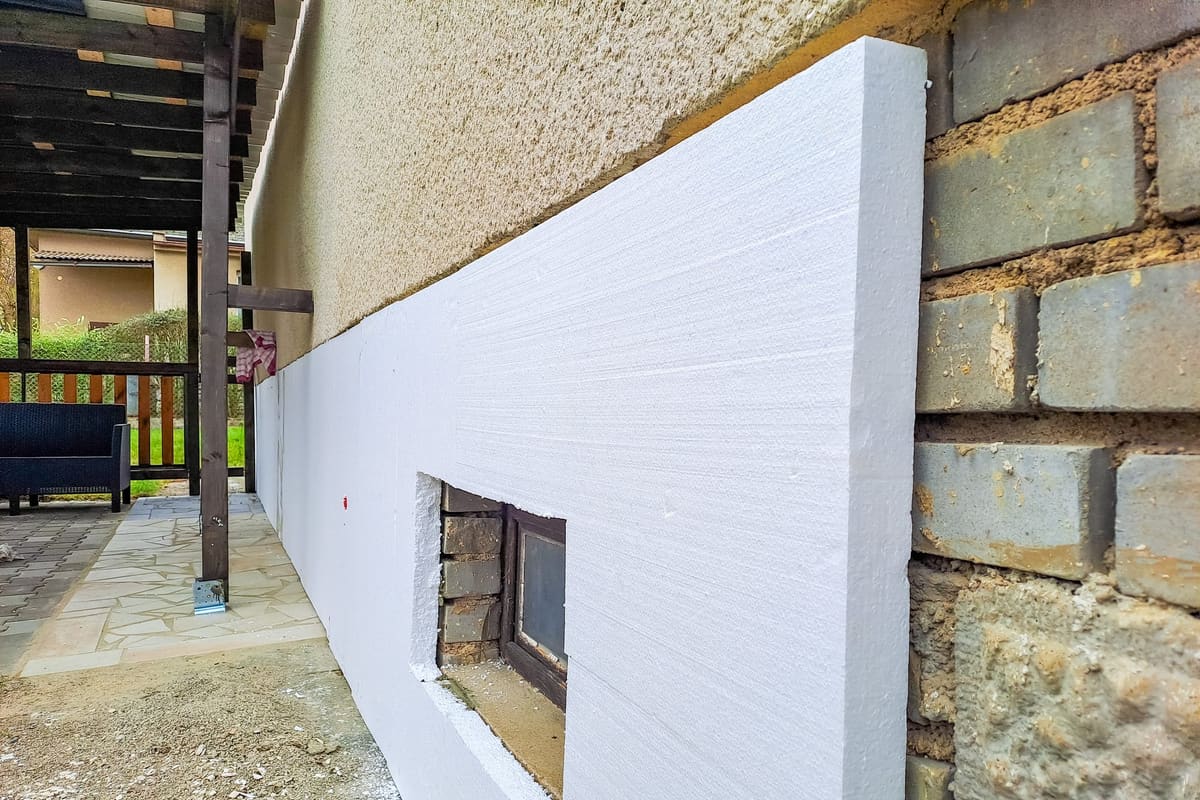
- Continuous insulation on the outside. It is the way to get the insulation in front of columns and slab edges without a break, which is exactly what the atlas rewards. What the system is and why it goes on the outside, on our SATE page.
- Insulating the roller-shutter box. It is one specific piece, and the difference between insulated and uninsulated is one of the biggest in the atlas.
- Insulating from the inside does not stop them. The lining is interrupted at every floor slab and every partition that meets the facade. Where the cold ends up in that case, in insulating walls inside or outside.
- Paint does not stop them. Neither anti-mould paint, which protects its own surface, nor paint sold as thermal. What it can do, with numbers, in our article on thermal paint.
If mould keeps coming back to the same corner, send us a photo of the corner and the nearest window, and we will tell you what is behind it before you paint again.
Frequently asked questions
What is a thermal bridge, in a nutshell?
What is a thermal bridge, in a nutshell?
A spot in the facade, roof or floor where the home loses more heat than through the rest, because the insulation is missing, broken or different there: a column, the edge of a floor slab, the surround of a window, the roller-shutter box. As well as wasting energy, it stays colder on the inside, and that is where mould grows.
How do I know if my home has thermal bridges?
How do I know if my home has thermal bridges?
Every home has them; the question is how much they matter. The clue indoors is mould or damp that keeps coming back to the same places: the corner where there is a column, where the wall meets the ceiling, around a window, under the roller-shutter box. They are the points the Building Code atlas flags for condensation.
Does thermal paint cut off a thermal bridge?
Does thermal paint cut off a thermal bridge?
No. What cuts off a thermal bridge is the insulation running in front of the weak point without a break, and a film of paint does not insulate nearly enough for that. We go through the numbers in our article on thermal paint.
Does SATE get rid of thermal bridges?
Does SATE get rid of thermal bridges?
Those at columns and slab edges, almost entirely: the atlas gives 0.00 to 0.02 W/mK for a column with continuous insulation, against around 1 with the insulation cut off. Those around windows depend on how the insulation meets the frame, and the roller-shutter box has to be insulated separately.
Sources
- Ministerio de Fomento, Documento de Apoyo al Documento Básico DB-HE, DA DB-HE / 3 «Puentes térmicos» (January 2014).
- ANFAPA, «Mejora de la eficiencia energética. El Sistema SATE y la eliminación de puentes térmicos».
Quotations from Spanish-language documents are our own translations.