Blog · Interiors and prices
Anti-mould paint: what it does and when painting is not enough
What the preservative in an anti-mould paint does, the 80% limit in the Building Code and why mould returns to the same corner.
8 min read
The little black dots on the bathroom ceiling, the grey patch that appears behind the bedroom wardrobe every winter, the kitchen corner that turns black however often it is cleaned. Anyone looking for anti-mould paint almost always has one of these in front of them and wants it gone for good. The paint helps, but not in the way most people expect, and knowing exactly what it does is what separates painting once from painting every year.
Behind what follows are three data sheets for anti-mould paints, the European biocides regulation and the document of the CTE, the Spanish Building Code (Código Técnico de la Edificación), that explains how to check whether a wall is going to suffer condensation.
What is inside an anti-mould paint
An anti-mould paint is an ordinary emulsion with a preservative added. All three data sheets say so in almost the same words: it is a paint “with anti-mould preservative”. One of them even names the substances it contains, and explains what they are there for: “to protect the initial properties of the treated article”.
That way of putting it comes from the European biocides regulation. It has a group of biocides called “film preservatives”: products that control microbial deterioration and algal growth “in order to protect the initial properties of the surface” of materials such as paints. Another of the data sheets, for an additive you mix into the paint, puts it even more plainly: it reinforces “the fungicidal and algicidal protection of the surface film”.
In other words, anti-mould paint protects its own surface: it is a film on which mould finds it hard to grow. It does not dry the wall, it does not warm it and it does not change the air in the room. And it is precisely there, in the wall and in the air, that mould finds what feeds it.
Mould does not wait for the wall to drip
Many people associate mould with visible water: the drop running down the tile, the misted-up window. But the Building Code sets the limit much earlier. To limit the risk of condensation on a wall, its supporting document uses a simple criterion: “a maximum limit of 80% mean monthly relative humidity on the surface”. And it defines the temperature that meets it, which it calls the minimum acceptable, like this: “Minimum interior surface temperature to prevent the formation of mould”.
With the document’s own formulas you can work out where that line falls. With the air in the house at 20 °C and 55%, the wall drips when its surface drops below 10.7 °C, but it goes past 80% below 14.1 °C. Between the two there are more than three degrees in which the wall does not look wet and mould already has a foothold.
Before it drips
- Drips
- Mould, without a drop
- Safe
With the air at 55%, the default the Building Code gives for a home, the wall drips below 10.7 °C, but mould already has a foothold below 14.1 °C. A corner at 15 °C is safe.
With the same air at 70%, both lines rise, to 14.4 and 17.9 °C. The same corner never actually gets wet, but it now sits inside the mould band. And anti-mould paint does not change the temperature of that wall.
And those lines do not stay put: they rise with the humidity of the air. With the same air at 70%, the wall drips below 14.4 °C and the mould limit rises to 17.9 °C. An anti-mould paint moves neither of them, because it changes neither the temperature of the wall nor the water in the air. If you have been offered an “anti-condensation” paint to raise that temperature, what it can actually do is covered in our article on thermal paint.
Why on the coast it comes back to the same corner
55% is the value the document proposes for a home when there is no better data, and the document itself warns of its limit: “for a dwelling in a maritime area the indoor relative humidity may be much higher than the 55% indicated, and condensation may occur very easily”. It gives no figure, but none is needed to see which way it goes: by the sea, both lines in the diagram sit higher.
The figures in its own climate table explain it. In January, Málaga and Madrid have the same mean relative humidity, 71%, but Málaga is at 12.2 °C and Madrid at 6.2 °C. With that difference in temperature, the air in Málaga holds half as much water again. And Málaga’s mean humidity does not drop below 59% in any month of the year.
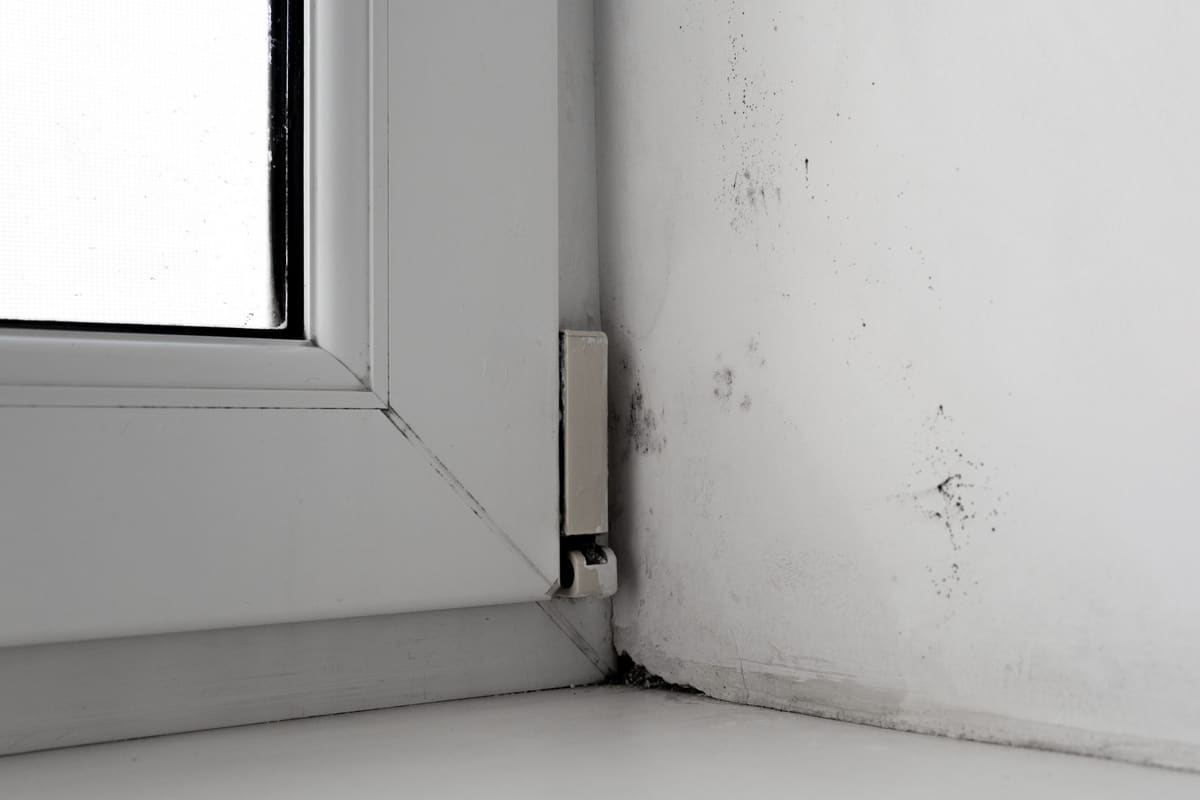
What does not change is where it appears. Mould comes out on the coldest part of the wall: the corners, where the wall meets the ceiling, around the windows, the north-facing bedroom wall, behind a wardrobe pushed up against it. These are the spots where the surface stays a few degrees below the rest, and that is why the patch comes back to the same corner however much it is painted. Why corners and the edges of floor slabs stay colder is explained on our external wall insulation page, along with what happens when a building is insulated from the outside.
When painting is enough, and when it is not
It is enough, or nearly, when the mould has a cause that can be removed. The bathroom ceiling that stays steamed up after every shower, the kitchen where pans boil without the extractor on, the room that is rarely aired. One of the data sheets defines its scope like this: walls and ceilings “prone to mould formation due to a high degree of humidity or lack of ventilation”. There, anti-mould paint does its job, as long as the water in the air has a way out.
That way out is what the Building Code requires of homes: a ventilation system in which “the air must flow from the dry rooms to the wet rooms”, with air inlets in bedrooms and living room and extracts in kitchens, bathrooms and toilets. If your flat has those vents, do not block them. If it does not, ventilation depends on the windows, and that works in winter too: outside air in Málaga in January, warmed to 20 °C inside the house, comes out at around 43% humidity, below the 55% the Building Code takes by default for a home.
It is not enough when the wall is getting wet from somewhere else. One of the data sheets puts it in writing: its anti-mould paint “is not suitable for painting directly onto surfaces with permanent or intermittent damp coming from leaks or from outside”. A leaking pipe, water getting in through the facade or damp rising from the ground has to be stopped first, and no interior paint does that.
Nor is it quite enough when, even with ventilation, the mould reappears in the same place year after year. That is a wall that is too cold, and what fixes it is raising its temperature: insulating it, from inside or outside. In that case anti-mould paint protects its own surface, but the wall is still inside the mould band.
How to paint a wall that already has mould
First it is cleaned, and not with the paint. The data sheets ask for this expressly: “Surfaces contaminated with mould must be washed and decontaminated first”, says one, with its own cleaner; another says to clean the stains “with bactericide / bleach”. One of them boasts that its paint “also covers existing stains (greenish or blackish)”, and it is true that it covers them, but the same data sheet asks for them to have been cleaned first. Covering mould without removing it is just painting over it.
After that, the wall has to be dry, and so does the air. One of the data sheets forbids applying it with the relative humidity at 80% or more, or below 7 °C: in a bathroom, that means painting with the shower turned off for a good while and the window open, not straight after. Two of the three ask for two coats; the third, one or two.
What really varies between two homes is the work beforehand: whether crumbling plaster has to be made good or a water leak fixed. How the job changes for a wall with mould compared with a sound one is on our page on painting a flat.
Frequently asked questions
Does anti-mould paint kill the mould that is already there?
Does anti-mould paint kill the mould that is already there?
That is not what it promises. Its preservative protects the film being applied, not the wall underneath. That is why the data sheets ask for the wall to be cleaned first: one with an anti-mould cleaner, another with a bactericide or bleach. Painting over mould without cleaning it covers it up; it does not remove it.
Anti-mould or anti-damp?
Anti-mould or anti-damp?
It depends on where the water comes from. If it comes from the air in the house — the shower, the cooking, breathing — and condenses, that is anti-mould territory, together with ventilation. If it comes from outside, from the ground or from a pipe, one of the data sheets is clear: its anti-mould paint is not suitable for that, and it points you to waterproofing.
Can I paint the bathroom ceiling with anti-mould paint?
Can I paint the bathroom ceiling with anti-mould paint?
It is one of its uses: one of the data sheets names kitchens, bathrooms and cellars, and another names kitchens and rooms with butane heaters. But on the day you paint, wait until the bathroom is dry. One of them says not to apply it with the air at 80% humidity or more, and a bathroom that has just been used, with the steam still in the air, can easily be above that.
Does anti-mould paint come in colours?
Does anti-mould paint come in colours?
All three come in white or light colours: one can be tinted to pastel shades with a maximum of 5% colourant, and another has a base for light colours. For any other colour, that same manufacturer suggests its ordinary emulsion and, to reinforce it, an anti-mould additive that is mixed into the tin.
How many years does the anti-mould effect last?
How many years does the anti-mould effect last?
None of the data sheets we have read gives a figure, and we are not going to make one up. What is known is that the paint protects its own surface; it does not correct the cause. If the corner stays cold and the air stays humid, the mould will have the same conditions it had before you painted.
Sources
- Documento de Apoyo DA DB-HE/2, «Comprobación de limitación de condensaciones superficiales e intersticiales en los cerramientos», a supporting document of the Spanish Building Code on checking surface and interstitial condensation (October 2013).
- Sección HS 3 «Calidad del aire interior», indoor air quality, in the Building Code’s Basic Document on health and hygiene (DB HS).
- Reglamento (UE) n.º 528/2012, relativo a la comercialización y el uso de los biocidas, the EU Biocidal Products Regulation, Annex V.
- Bruguer, ficha técnica de «Pintura con conservante antimoho» (technical data sheet, version 03/15).
- Titan, ficha técnica de «Pintura con conservante antimoho H22» (technical data sheet, September 2020).
- Revetón, ficha del «Sistema antimoho» (product data sheet).
Quotations from Spanish-language documents are our own translations.