Blog · Insulation and energy efficiency
Thermal paint: how much it really insulates and where it works
What the data sheets of thermal paints say, and why reflecting the sun on a roof is not the same as insulating a wall.
8 min read
A paint that insulates as if the wall were thicker: that is how thermal paints are sold, and on the coast the promise sounds good, because the August heat comes in through the roof terrace and in winter the north-facing walls wake up wet. We have read the data sheets of four manufacturers and what the CTE, the Spanish Building Code (Código Técnico de la Edificación), says about how to calculate what a layer insulates.
The answer is not the one in the adverts. Nor is it that they are useless: they are useful for something else, and in one particular place in the house.
What goes into a thermal paint
Almost all of them are water-based acrylic paints with hollow particles mixed into the formula. One of the data sheets describes it as “very low thermal conductivity through the incorporation into its formula of hollow microspheres and special reflective pigments”. Another talks of “glass nanospheres”, and a third, designed for roofs, of an “aerating agent that generates microbubbles”. The idea is the same in all three: fill the paint film with trapped air, which is a poor conductor of heat.
And they do conduct little, that much is true. Thermal conductivity, the λ you see on data sheets, measures how easily a material lets heat pass through it: the lower, the better. Two of the data sheets declare 0.056 and 0.048 W/m·K, which are low values. The problem is not that number, but the one that usually sits next to it.
What a layer insulates depends on its thickness
The Building Code does not measure insulation by conductivity but by the thermal resistance of each layer, and it calculates it with a one-line formula: resistance is thickness divided by conductivity, R = e/λ, with the thickness in metres. The thicker the layer, the more resistance. An excellent material in a very thin layer resists very little.
The data sheets give the thickness too. The 0.056 one calls for a “Minimum Thickness 500 microns, 2 coats recommended”: half a millimetre. The 0.048 one recommends “at least 2 coats of paint equivalent to a total dry thickness of between 300 and 400 microns”. Using the Code’s formula, half a millimetre of the first gives a resistance of 0.009 m²·K/W, and four tenths of a millimetre of the second, 0.008.
On their own those numbers say nothing, so they need to be set beside other layers. The same Code has a table with the resistance of the film of still air that forms against any wall: on the inside face of a wall, 0.13. And it sets a maximum transmittance for walls according to the climate zone. The province of Málaga runs from zone A3 to D3 depending on altitude, and the coast is in A, the mildest on the Spanish mainland, where a wall cannot exceed 0.70 W/m²·K. That is the same as saying all its layers together must add up to at least 1.43.
What each layer insulates
Half a millimetre of thermal paint. With the conductivity and the minimum thickness its data sheet declares, it comes to 0.009. It is that sliver at the start: you can barely see it.
The air that does not move against the wall. The Building Code gives 0.13 to that invisible film on the inside face, which every wall has, painted or not: almost fifteen times more.
What the whole wall has to add up to. To stay within the limit for zone A, the mildest on the Spanish mainland, it has to reach 1.43. The paint contributes less than 1%.
Half a millimetre of thermal paint contributes less than the air that is already there for free, and less than 1% of what the Code requires of a wall in the mildest zone on the Spanish mainland. For that same paint to add a resistance of 1, it would have to go on more than five centimetres thick. That is why no insulation job is ever solved with a tin of paint.
How to read a thermal paint data sheet
- What the conductivity refers to. One of the data sheets, after presenting its paint as having “very low conductivity”, gives this figure: “Thermal conductivity of the same of 0.05 W/m.K”. Read carefully, “the same” is the microsphere it has just described, not the paint. It is the figure for one ingredient.
- At what thickness. A conductivity without a thickness does not tell you how much it insulates. If the data sheet does not give the thickness once dry, there is no way to calculate anything.
- Where the number comes from. One of the data sheets backs it with a report from a construction laboratory, with its date and its “thermal conductivity tests”. Another cites the standard UNE-EN ISO 6946, which the Building Code documentation lists as a “Calculation method” for the resistance and transmittance of components, not as a test.
- What it promises. One data sheet states that its paint “complies with the requirements of the Building Code for insulating materials”. In the Code’s energy-saving document, the one that sets how much a building has to insulate, the expression “material aislante” (insulating material) does not appear: what is limited is the transmittance of the whole wall, roof or floor. Another lists among its uses “Breaking the thermal bridge at slab edges and pillars”, with the resistance of 0.009 we have just calculated.
Where it does work: the roof terrace in the sun
There is one place where a paint of this kind does something you can notice, and on the Costa del Sol it is precisely the one that takes the worst of it: the flat roof under the July sun. There, what counts is not how much the film conducts but how much light it sends back. The Building Code calls this absorptivity: the fraction of solar radiation a surface absorbs, from 0 to 1. Whatever it reflects, it no longer absorbs.
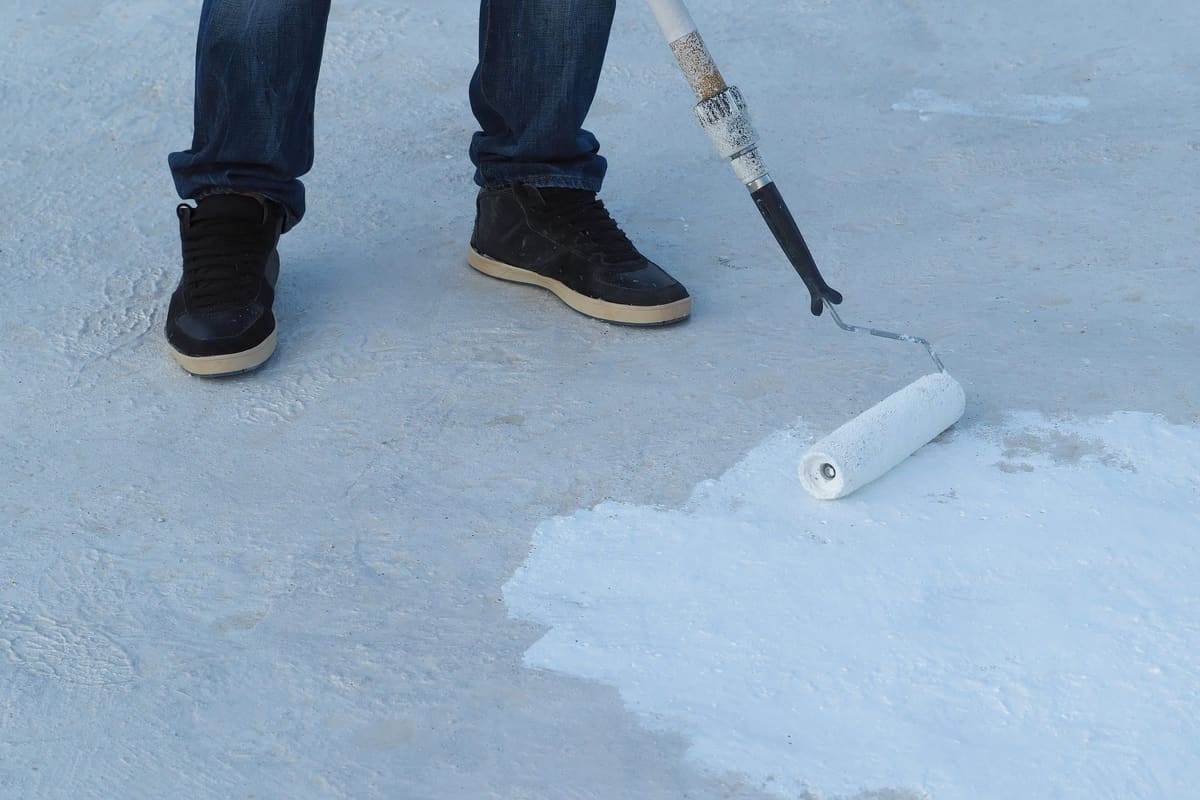
The data sheet that shows it best belongs to the most conductive paint of the four. Its conductivity, measured in a laboratory, is 0.4762 W/m·K, between eight and ten times that of the other two; but its solar reflectance is 89.28%, and the manufacturer calls it what it is: “It is a THERMOREFLECTIVE paint”. It calls for two millimetres of thickness and recommends it for “terraces, roofs”. What it does is make the roof terrace heat up less in the sun, not insulate it.
In a penthouse, or in a single-storey house where the ceiling is the roof terrace, that difference reaches the rooms below. If that is what you are after, the figure to ask for is the measured solar reflectance, not the conductivity. And on a roof, as well as reflecting, the coating has to stand up to sun and water: some of these paints are also sold as waterproofing.
Condensation and mould
This is the other promise, and one of the most searched for: “anti-condensation” paint. In winter, the moisture in the coastal air condenses on the coldest walls of the house, which tend to be the north-facing ones and the corners, and that is where mould appears. It condenses because that wall is colder than the air inside, and a layer with a resistance of 0.009 barely changes its temperature.
What many of these paints do bring is something else: a preservative in the film. One of the data sheets puts it like this: “prevents the appearance of fungus and algae stains on its surface”. That is useful, but it is the job of an anti-mould paint, not of an insulator. If the patch comes back to the same corner every winter, the answer lies in ventilating, heating or insulating that wall; what a mouldy wall needs before it is painted is covered in painting a flat or house.
If what you want is insulation
Insulating means adding centimetres, not microns. In a house that is already built there are two routes: from inside, with dry lining that takes space from every room, or from outside, wrapping the facade in an insulation system. The outside route has an advantage that counts on the coast: it also covers the slab edges and the pillars, which is where the heat escapes and where the condensation in the corners starts. How it works and when it pays off is on our external wall insulation (SATE) page.
And if what keeps you up at night is the heat under the roof terrace, a well-chosen reflective paint is a reasonable improvement. You just have to ask of it what it actually does.
Frequently asked questions
Does thermal paint work indoors?
Does thermal paint work indoors?
As insulation, not much. At the thickness its data sheets call for, its thermal resistance is lower than that of the air already clinging to the wall, and below 1% of what the Building Code requires of a wall. You cannot expect it to show on the heating bill or the air-conditioning one. If it contains an anti-mould preservative, it does help keep stains from appearing on the paint film.
And on the facade, outside?
And on the facade, outside?
As far as insulation goes, the same as inside: resistance depends on thickness, and outside it is also a few tenths of a millimetre. What does count on a wall in the sun, just as on a roof terrace, is how much light the surface sends back. If you are offered it on that basis, ask for the measured solar reflectance, which is the figure that proves it.
How thick does it need to go on?
How thick does it need to go on?
As thick as its data sheet says, without falling short: in the ones we have read, between 300 and 500 dry microns for interiors, and two millimetres in the one for roofs. That is why they all call for two or more coats. One of them explains it like this: a minimum spreading rate is needed for the film to have “the thickness necessary to allow it to fulfil its purpose”.
Is it worth it in a flat on the coast?
Is it worth it in a flat on the coast?
It depends what for. To insulate walls, no: it is far too thin for what is needed. For a penthouse, or a house with its roof terrace in the sun, a well-chosen reflective paint does make sense. And for mould in a bathroom or a corner, the work is done by the anti-mould agent, which paints not sold as thermal also contain; the cause has to be looked for in the ventilation or in the wall.
Sources
- Pinturas Arenas, data sheet for “Thermo – Interiores”.
- Basther Hispania, data sheet for “Painter”, an insulating paint.
- Pinturas Isaval, data sheet for “Termoaislante anticondensación” (1198, version 7).
- Moype, data sheet for “Moypetermic”, a heat-insulating waterproof coating.
- Código Técnico de la Edificación, DA DB-HE/1, “Cálculo de parámetros característicos de la envolvente” (January 2020): the resistance formula and the surface resistances.
- Código Técnico de la Edificación, Documento Básico HE, “Ahorro de energía” (consolidated text of June 2022): table 3.1.1.a, terminology and climate zones.
Quotations from Spanish-language documents are our own translations.