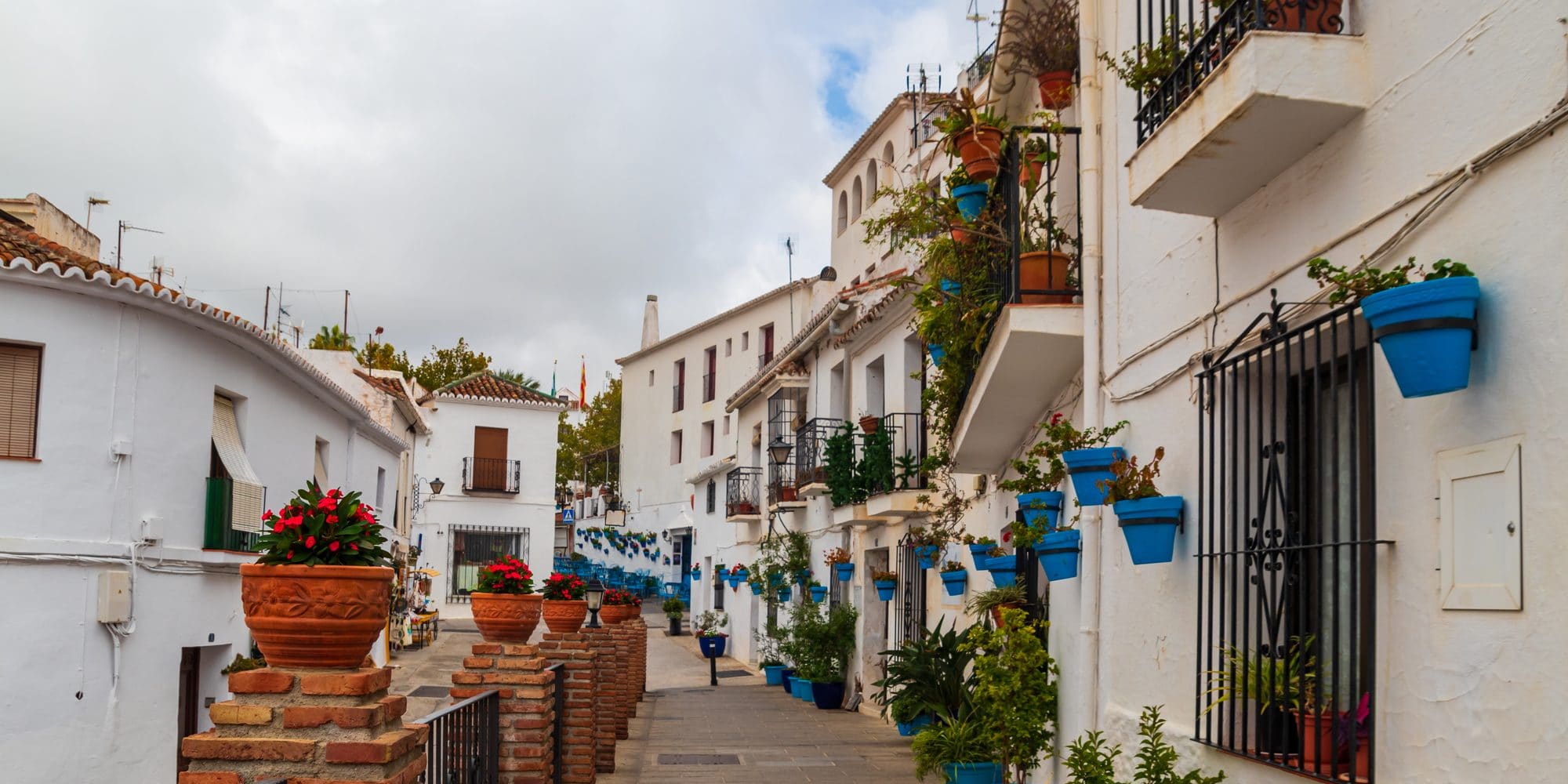
Painters in Mijas: the white of the Pueblo and the urbanisation villa
Painting for houses, villas, facades and interiors across the municipality of Mijas. Here the colour of a facade is set by the by-law: white in the Pueblo, preferably white in La Cala, and nowhere a cement-grey wall. And the building inspection starts at 25 years.
Las Lagunas · Mijas Pueblo · La Cala de Mijas · Calahonda · Riviera del Sol
From whitewashing to interiors
The general side of each job is on its own page. Here, what changes when the house is in Mijas.
Facade painting
To whitewash or repaint the front of a house in the Pueblo, in La Cala or on an urbanisation villa.
Facade repair
So the render is sound before the white goes on: cracks, flaking and hollow patches.
Facade waterproofing
So that rain does not streak a freshly whitened wall grey again.
Communities of owners
For groups of terraced houses and blocks whose owners decide at their meeting.
Painting a flat or house
To paint a home or an apartment inside, all of it or room by room.
Sand effect
For a textured finish on an interior wall instead of the usual smooth one.
White is not chosen: it is maintained
The municipal by-law on conservation, refurbishment and dilapidated buildings devotes its article 28 to special rules for the town centre. These are the ones that matter to whoever is going to paint.
Mijas Pueblo, in whiteThe colour the by-law sets
In the town centre of Mijas Pueblo, “white is designated for the whitewashing of facades”. There is no colour chart to choose from: what gets decided is the type of paint and how the wall is prepared.
La Cala, preferably whiteTo look after its image as a coastal village
In La Cala de Mijas the rule asks for white to be used by preference, “avoiding a confusion of shapes, textures and colours”. It is not as categorical as in the Pueblo, but it points the way.
No cement greyAnywhere in the municipality
No facade in Mijas may be left cement-coloured or unrendered. That goes for a half-finished house too: render and paint are not optional extras.
What cannot be seen, tooParty walls and exposed walls
Facades, party walls and exposed walls must be kept safe, sanitary and presentable even when they cannot be seen from the street. And cabling on facades is banned.
Owners of homes in poor decorative condition are obliged to whitewash and tidy up their facades. If they do not after the formal request, the council does it and passes the costs on to the owner.
Before whitewashing, the render has to be firm: facade repairs.
A village protected for its whiteness since 1969
On 24 June 1969 the Spanish Official State Gazette published the declaration of Mijas as a historic-artistic ensemble.
As the council explains, it was the first town in Andalusia to be given that status for its typical character and picturesqueness, unlike the monumental cities that had it before. The decree spoke of “the very simplicity of its buildings of thorough whiteness, with railings and balconies full of flowers”.
The protected area covered the village core, some 28 hectares. Today the town planning department’s forms include a specific one for prior authorisation of works in the Conjunto Histórico Artístico: before any work in the Pueblo, it is worth knowing whether it is needed.
In Mijas the ITE starts at 25 years, villas included
The same by-law regulates the ITE (the periodic technical inspection of buildings). The obligation covers every kind of building and structure more than 25 years old, whatever its use: the apartment block and the detached house on an urbanisation alike.
After the first one, the inspection is repeated every 7 years while the building is under 50, and every 4 from that age. The council can also require it earlier, giving reasons and a deadline of its own.
The report is drawn up by a qualified technician chosen by the owners, stamped by their professional association, and filed at the council’s registry together with the building’s technical record and an undertaking to carry out the work it lists.
On facades, the technician looks above all at anything that could fall into the street: slab edges, cornices, cladding. On watertightness, at walls and external joinery. The work comes out in order of priority, with start and completion deadlines and an estimated budget.
Improvement orders on aesthetic grounds
Article 14 of the by-law allows the council to order improvement works on facades, roofs or spaces visible from the street for reasons of tourism, culture or appearance, so that the building fits its surroundings.
It can do so, for example, when the facade is in poor condition or when a party wall is left exposed and untreated. Anything beyond the normal duty to maintain the building is paid for by whoever orders it. For the owner, a well-kept white facade is the simplest way never to receive that order.
Before you call, three questions about the house
Is it in the Pueblo?
Within the Conjunto Histórico (the protected historic town), works have their own prior-authorisation form at the town planning department. Find out before touching the facade, even just to whitewash it.
Is it over 25 years old?
Then the ITE applies, whether it is a block or a villa. If the report calls for work on the facade, the painting is scheduled after it and within its deadlines.
Is there an order?
If the council has already ordered the facade to be whitewashed or tidied up, the clock is running. The sooner the wall is looked at, the sooner you know what needs repairing first.
If the house is already over the line in Fuengirola, the rules there are different: painters in Fuengirola.
Questions about painting in Mijas
Do you work throughout the municipality of Mijas?
Do you work throughout the municipality of Mijas?
Yes: in Las Lagunas, Mijas Pueblo, La Cala de Mijas, Calahonda, Riviera del Sol and the urbanisations across the municipality. Tell us where the house is and what the job involves, and we will book a visit.
Does the facade have to be white in Mijas?
Does the facade have to be white in Mijas?
In the town centre of Mijas Pueblo, yes: the conservation by-law designates white for whitewashing facades. In La Cala de Mijas it asks for white by preference. And throughout the municipality it bans leaving facades cement-coloured or unrendered.
What happens if I do not whitewash the facade?
What happens if I do not whitewash the facade?
Under the by-law, the mayor can issue a decision listing the defects, the measures and a deadline. If it is not complied with after the formal request, the council can carry out the whitewashing and tidying itself, with all the costs charged to the owner.
Does my villa need an ITE?
Does my villa need an ITE?
If it is more than 25 years old, yes: the Mijas by-law covers every kind of building and structure of that age, whatever its use. The inspection is repeated every 7 years while the building is under 50, and every 4 years from then on.
Can the council make me improve my facade?
Can the council make me improve my facade?
It can issue enforcement orders for facades and roofs visible from the street for reasons of tourism, culture or appearance. Under the by-law, anything beyond the normal duty to maintain the building is paid for by the body that orders it.
Where this comes from
Quotations from Spanish-language documents are our own translations.
Time to whitewash or paint in Mijas?
Tell us whether the house is in the Pueblo, on the coast or on an urbanisation, and whether an ITE or a council order is involved. We come and see it and send a written estimate, each job listed on its own.