Skip to content
Pintoresdel Sur
External wall insulation

External wall insulation: insulating the facade from outside

External thermal insulation systems for houses and buildings in the province of Málaga — what quotes in Spain call SATE (Sistema de Aislamiento Térmico por el Exterior), known in the standards as ETICS. Here it is not put on for the heating: it is put on because the facade stops storing up the afternoon sun and releasing it indoors, and because wrapping the building from outside covers exactly the points that insulation on the inside cannot reach.

Start here

External wall insulation is four layers

It is not a matter of “sticking on polystyrene and painting”. It is a system, and it works because the four layers work together: if one is swapped for something cheaper, the whole stops behaving as expected. Knowing what they are is what lets you compare two quotes properly.

The insulation

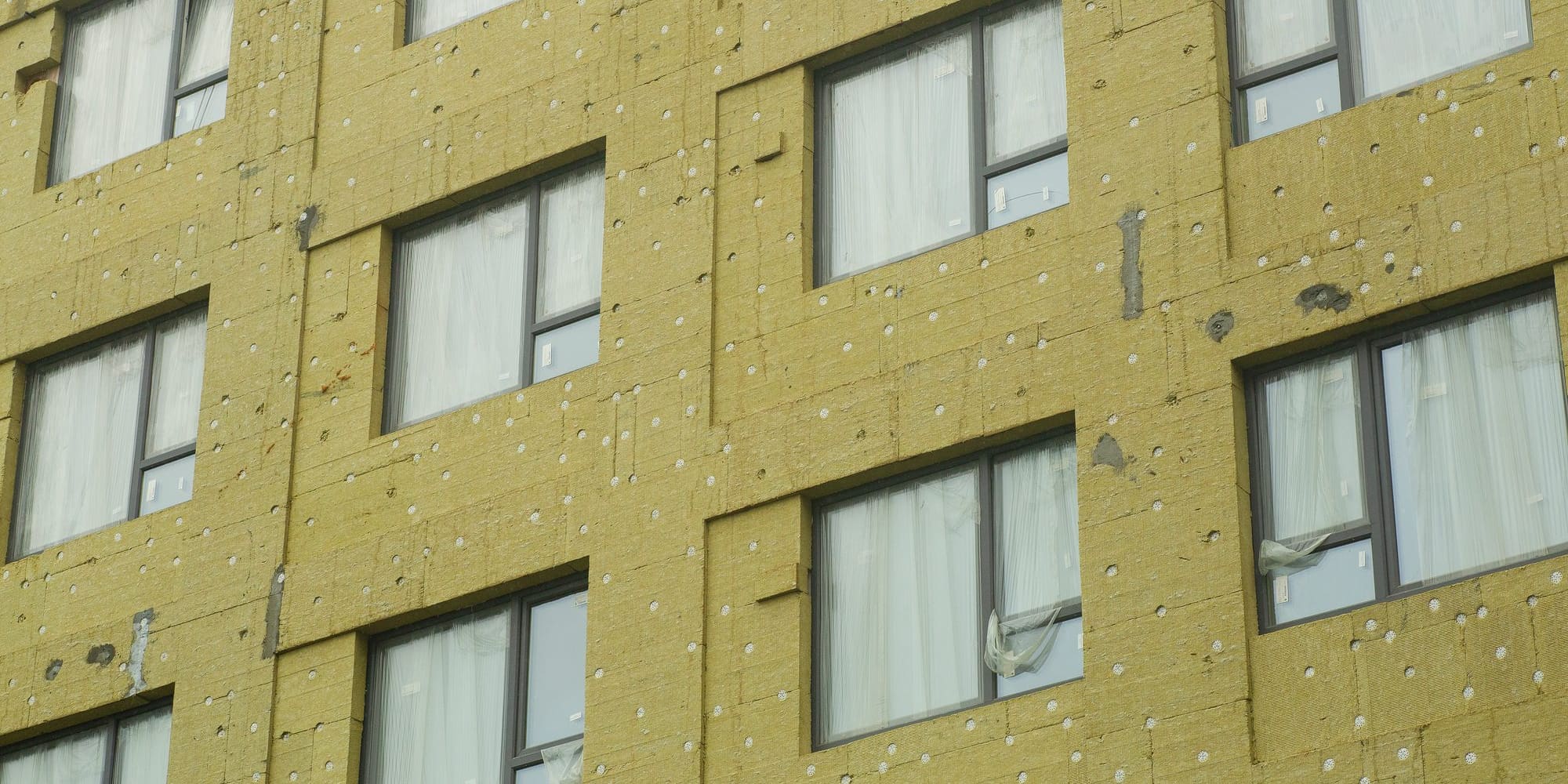
Boards bonded to the facade and, on top of that, secured with fixing anchors. Neither fixing is redundant: the adhesive does its job for as long as the surface behind it holds, and the anchors are what take the strain when the wind blows hard. The material and the thickness are chosen according to what you want to achieve and how much room the building has on the outside.

The base coat with mesh

A mortar with a glass-fibre reinforcing mesh embedded in it, not stuck on top. It spreads the movement of the whole system so that the joints between boards do not end up showing through the finish, and it is what gives the system its impact resistance. At corners and around windows and doors it is reinforced, because that is where the stress concentrates.

The finish

The layer you see, and the only one chosen on looks. It has to be compatible with what is underneath and let vapour out: a well-installed system topped with a watertight product is a system that gets damp inside without anyone knowing until a stain appears.

The detailing

The starter at ground level, the top edge, window sills, reveals, downpipes, grilles, air-conditioning units. They are not a finishing touch: if they are done badly they are where the water gets in, and they are half the real work of an insulation job. A system fails at its edges, almost never in the middle of the wall.

The real question

Why outside and not inside

Insulating from inside is cheaper and quicker, and in some cases it is the right call. But there are three things you only get by wrapping the building, and one of them explains most of the damp patches that appear in corners.

  1. The thermal bridgeWhat insulating from inside leaves out

    Insulating from inside leaves uncovered precisely what runs through the wall: the edge of the floor slab on every storey, the columns, the lintels over the windows, the junction with the balconies. Those points are still connected to the outside, so they keep conducting heat, and inside they stay colder than the rest of the wall. That is why damp patches and mould always appear in the same corners of the room, not in the middle of the wall. External insulation wraps the building from outside, and those points are no longer exposed.

  2. What it does not take from youNeither floor space nor your home

    Internal dry-lining eats several centimetres all the way round the room, and in an ordinary flat that adds up to real square metres. External insulation grows outwards, so you lose no floor area. And because the work is done from the scaffold, there is no need to empty rooms or live with the building work inside, which is the difference between a job that is a nuisance and one that forces you to move out.

  3. The thermal mass of the wallThe wall ends up on the inside

    When you insulate from outside, the whole mass of the wall stays inside the wrapping. That makes the indoor temperature change more slowly: it takes longer to heat up when the sun is at its strongest and longer to cool down at night. On a coast where the problem is not the cold in January but the heat in July, with the air conditioning running all afternoon, that slowness is exactly what you are after.

That said, the outside does not always win. If the facade is heritage-protected, if it is almost all glass or if only one particular room needs sorting out, internal dry-lining is the sensible answer, and we will tell you so.

Plain talking

What to bear in mind before having external wall insulation fitted

It grows outwards, and that has to be measured

The system adds thickness to the facade, and everything that used to be flush no longer is: window sills end up too short, grilles and downpipes have to be moved out, the eaves may no longer overhang enough, and at the bottom you have to check where the property boundary is. It is not a problem — the detailing deals with it — but it is decided beforehand, not as the job goes along.

If your problem is water, this is not the answer

External insulation is for heat and cold. It does not seal a crack that lets in the rain driven by the levante, the easterly wind, nor does it stop damp rising from the ground, and covering it up with insulation only means you take longer to see it. When water is involved, you first find where it gets in and fix it; the insulation comes afterwards, on a facade that is already dry.

What happens to a facade on this coast

In a block of flats, the job starts at the owners’ meeting

Here the work starts long before the scaffold goes up. External insulation is an energy-efficiency intervention, so as well as being voted on by the comunidad de propietarios (the community of owners) it has to be documented, and the scaffold stays up a good deal longer than for a paint job: the neighbours need to be told that beforehand, not afterwards. It is also worth checking which public energy-renovation programme is open at the time — there are some, but the calls, deadlines and requirements change — and not counting on any of them until you have it confirmed in writing.

Questions

What people ask us most about external wall insulation

Is external wall insulation worth it on the coast, with the winters we have?

Here the argument is not the winter, it is the summer. What you notice first is that the facade stops soaking up the heat of the day and releasing it indoors in the afternoon, which is when the air conditioning works hardest. Winter improves too, especially at the spots where condensation used to form, but if someone sells you external insulation for the heating in Málaga, they are giving you an argument from another climate.

Can it be done for a single flat, or does it have to be the whole building?

Technically you can insulate one section of wall, but it rarely makes sense. The facade is a common element of the building, so the decision is not yours alone; and even if it were, a patch of insulation surrounded by uninsulated wall keeps losing heat at its edges and can be seen from the street. In a detached house, on the other hand, you decide and the whole house is done.

How thick does it need to be?

It depends on how the wall is built, which way each side faces and how far the facade can grow without swallowing eaves and window sills. It is not simply “the more the better”: past a certain point each extra centimetre adds less and complicates all the detailing. It is calculated for the specific building, not copied from next door.

Can it take a knock? What if someone leans a ladder against it?

It is a system with insulation underneath, so it stands up less well to a sharp impact than a solid wall. That is why the ground floor and areas where people pass are built reinforced, with extra mesh. A hard knock can dent the finish; it can be repaired, but it is worth knowing beforehand rather than finding out with the first bicycle leaned against the entrance.

What maintenance does it need?

That of whatever finish you put on it, not of the insulation, which is protected. What does need checking from time to time are the edges: the top edge, the window sills and the junctions with the window frames, which is where a system starts to fail. Checking them every so often costs little; finding problems late costs a lot.

How much does external wall insulation cost?

It is measured per square metre, but the figure is driven by four separate decisions: which insulation and how thick, what it is finished with, what access equipment is needed to get up there, and how much repair the wall needs before anything can be bonded to it. All four are decided with the building in front of you, so no figure given over the phone means anything. What we give is a fixed written quote after measuring.

We will tell you if your facade is a candidate

Tell us whether it is a house or a block, how many storeys it has and which side becomes unbearable in the afternoon. With that we can already say whether external insulation is right for you or whether something else would suit you better, and if it is, what would need looking at on the visit.

CallQuote