Blog · Gotelé and skimming
Wallpaper over gotelé: what the data sheets ask for before you hang it
What paste data sheets and hanging guides demand of the wall, and why gotelé, distemper and coastal damp fall short.
7 min read
Papering over gotelé looks like the quick way to get rid of it: a few rolls, one afternoon, and the wall is transformed. The question is whether the paper will hold. To answer it we went to what the people who make the paste and sell the paper write in their data sheets and hanging manuals. All three ask the same of the wall, and gotelé does not meet it.
That does not mean it always has to be stripped. It means the paper does not go on the gotelé, but on whatever is done to it first.
What the wall needs, according to the data sheets
The data sheet of a professional wallpaper paste sums up the base in a single line: “plan, lisse, sain, sec en permanence (non exposé à des remontées d’humidité), propre, solide, dégraissé et dépoussiéré, de porosité normale”. In English: flat, smooth, sound, permanently dry (with no rising damp), clean, solid, free of grease and dust, and of normal absorbency.
The hanging manual of a German wallpaper manufacturer, in its Spanish distributor’s edition, puts it another way: the wall surface “must be dry, sound, evenly absorbent, clean and smooth”. And a paint shop’s hanging guide says the same: the base “must be dry, smooth, sound, resistant and absorbent”.
Three sources, three lists, and “smooth” in all three. Gotelé is the exact opposite: a wall made on purpose not to be smooth.
What the paper touches
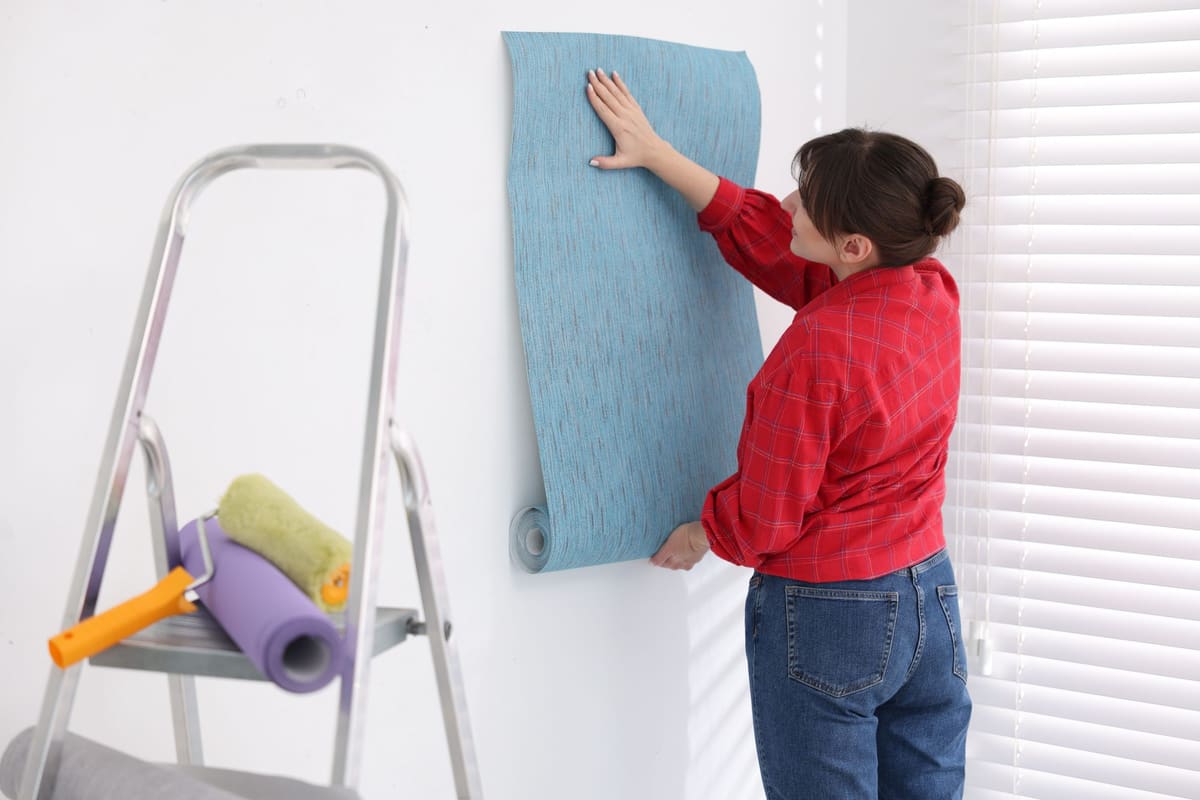
Wallpaper does not fill: it rests. The paste works where the paper touches the wall, and on gotelé what it touches are the peaks. Between one and the next there is a gap, and there the paper is hanging in the air.
What the paper touches
Over gotelé, the paper only touches the peaks. Between them it hangs in the air, and there the paste has nothing to grip.
With light from the side, every peak casts its shadow on the paper. The texture it was meant to hide shows through.
With the wall skimmed first, the paper bonds across its whole surface, which is what the data sheets ask for: a smooth base.
The manual gives a clue to what happens with texture the paste cannot reach, although it says it about the paper’s own relief: “it is important that the paste also penetrates the deepest parts of the relief. Otherwise, different drying tensions will form”. With the texture on the wall, the problem is the same, just on the other side.
Then there is the light. Before papering, the manual advises checking the wall because “irregularities can be detected better with a strong light source”. Whatever that light shows before will still show after: paper copies the wall beneath it. The manual says wallpaper hides “small imperfections”, and gotelé is not a small imperfection; it is a whole texture. The higher the relief, the bigger the gap under the paper; how to recognise yours is in the types of gotelé.
If the gotelé is distemper, the problem is the paste
Distemper gotelé is a paint that softens with water, and wallpaper paste goes on wet. The paste data sheet is blunt about paints of that family: it asks for “badigeons” (water-based limewash and distemper paints) to be removed before papering, and for “friables, farineux” bases, the ones that crumble or shed powder, to be stabilised. If you are not sure whether yours is distemper or plastic, you can tell with the sponge test.
The manual suggests another test, just as simple: stick on a piece of tape and pull. “If the old paint sticks to the adhesive tape, it must be removed”. And it explains what happens if you skip it: when the base comes away, that “does not guarantee the adhesion of the wallpaper. Seams or whole strips can come away from the surface”.
If it is plastic gotelé, the problem is the opposite
Plastic gotelé is finished in emulsion, which is a dispersion paint, and there the paste has nowhere to go. The manual describes it like this: dispersion paint “is highly resistant to washing and blocks the base too much”, which “often causes extreme bubbling”. And it warns that the problem can take its time: “even after several weeks” seams may still open.
The fix both sources propose points the same way. The manual recommends a pigmented wallpaper primer, which regulates how much the wall absorbs. The paste data sheet says to key old or glossy paints with an alkaline wash, sand if needed, or apply a primer for non-absorbent surfaces and let it dry for “24 heures minimum”, at least a full day.
On the coast, damp comes before everything
Of everything the sources ask for, the one thing that admits no exceptions is damp. The manual, on surfaces with damp problems: “Under no circumstances is it suitable for wallpapering or for applying any other kind of covering. Mould forms very quickly on damp surfaces”. The paste data sheet sets the maximum for a plaster wall at 5% moisture, under the French wallpapering standard it refers to.
The paint shop’s guide gives a home-made way to find out: tape a piece of plastic film to the wall, leave it for 24 hours and see whether moisture has collected underneath. If it has, the wall is ventilated and warmed first. And the manual adds a sign to watch for afterwards: red or violet stains on the paper “are an indication of damp walls and/or mould”.
In a flat near the sea, the corner that goes mouldy every winter is exactly the one you do not paper until you have sorted out why it gets wet. Why mould keeps coming back to the same corner on this coast: anti-mould paint and its limits.
The ways out
If the wall is dry and you want paper, the gotelé is dealt with first, and there are two ways to do it.
The first is to remove the gotelé: the natural route when it is distemper, which softens and comes off. The second is to skim over it with filler, when it is plastic and well bonded. Either way the result is what the data sheets ask for: a smooth, sound wall.
On that wall, the manual often recommends a non-woven lining paper under the decorative paper, which “prevents the paper’s seams from opening” and balances the tension between wall and paper. And if the paper is a light colour, painting the wall first with a white primer so that the base is even.
Papering straight over gotelé is exactly what all three sources rule out by asking for a smooth base. If it is done anyway, it is worth knowing in advance what you will see when the afternoon sun comes in through the window.
Frequently asked questions
Can you put wallpaper over gotelé?
Can you put wallpaper over gotelé?
It will stick. But the three sources we read all ask for a smooth base, and gotelé is not smooth: the paper only grips the peaks, and the texture shows through as soon as light hits it from the side. What works is skimming the wall first, or removing the gotelé.
Does self-adhesive wallpaper cover gotelé?
Does self-adhesive wallpaper cover gotelé?
We have not found a data sheet that deals with it: the ones we read are about papers hung with paste. What they all say is that the surface has to be smooth and sound, and an adhesive that only touches the peaks has the same problem as paste.
Do I need to strip the old wallpaper first?
Do I need to strip the old wallpaper first?
Yes. The hanging manual is unequivocal: “Always remove the old wallpaper before papering”, because on top of another paper “there is a risk that it will not stick properly, that seams or bubbles will form or that the wallpaper underneath will show through”.
Do I need a primer before hanging wallpaper?
Do I need a primer before hanging wallpaper?
It depends on the base. On emulsion paint, which absorbs little, the manual recommends a pigmented wallpaper primer. On a new or very absorbent wall, too, “especially if it is a new, untreated wall”. On distemper gotelé, before priming anything, it has to come off.
What temperature should you hang wallpaper at?
What temperature should you hang wallpaper at?
The manual advises between 18 and 22 °C with no draughts, doors and windows closed, so that the paper dries evenly. The paste data sheet gives a working temperature of 10 to 25 °C. In summer on the coast, that means papering in the cooler hours.
Sources
- Bostik, ficha técnica of the paste «Quelyd Perfect» (edition of 21 May 2013), and its product page, which publishes the same surface preparation. In French.
- Disbar Papeles Pintados, «Manual del papel pintado. Guía completa de calidades y colocación» (2024) — a wallpaper quality and hanging manual.
- Pinturas Baños, «Guía para la colocación del papel pintado» — a wallpaper hanging guide.
Quotations from Spanish- and French-language documents are our own translations.