Blog · Facades and restoration
The ITE in Málaga: what it checks in your building and what happens if it fails
Who it applies to, what the surveyor looks at and which deadlines run when it fails, with the Málaga by-law in hand.
8 min read
If your building in Málaga is more than fifty years old, its community of owners (comunidad de propietarios) has an appointment with the ITE, the inspección técnica de edificios or technical building inspection. It is not a box-ticking formality: a surveyor goes through the building from the foundations to the roof terrace and signs off on whether it is in good condition or needs work. And if it needs work, deadlines start running.
Everything that follows is about the ITE in the city of Málaga, with its by-law in hand. Elsewhere on the Costa del Sol each town hall regulates it with its own, so the dates may differ. What happens to a facade by the sea does not.
What it is, and which buildings it applies to
Málaga’s municipal planning office, the Gerencia Municipal de Urbanismo, describes it as a periodic inspection whose purpose is “to carry out a check-up of the stability, safety, watertightness and habitability or effective use of buildings whose useful life, owing to their age and the passage of time, is assumed to be exhausted”. It is governed by the Ordenanza Municipal de Conservación e Inspección Técnica de las Edificaciones, the city’s by-law on the upkeep and technical inspection of buildings, in force since 14 December 2013.
It applies to every building in the municipality that is listed or more than 50 years old, with a single exception for small constructions on land classed as non-developable. And it is not something each owner does separately: in a block of flats, the obligation falls on the community of owners.
When your building’s turn comes
According to the by-law, the first inspection is submitted “within the thirteen months following the end of the year in which the building reaches 50 years of age”. Applied to this year’s round: in 2026 the buildings built in 1975 submit it for the first time, and the deadline is 31 January 2027. After that it is renewed every ten years; that is why buildings from 1965, which passed it for the first time in 2016, are also repeating it this year.
The age that counts is the one in the Catastro, Spain’s property register, and the Gerencia publishes the list of buildings required to submit in each round. If the Catastro date is wrong — because there was new building work or a demolition — you lodge an objection with the proof, which can be the certificate of completion (certificado final de obra), a land registry extract (nota simple) or even aerial photographs, and the Catastro is corrected. Apart from the general deadlines, the Gerencia can require the inspection at any time, giving its reasons, with at least 20 days to submit it.
What the surveyor looks at
It is carried out by a professional registered with their professional body, hired by the community: architects, technical architects (arquitectos técnicos or aparejadores) and building engineers in every case, and other engineers as allowed by the Ley de Ordenación de la Edificación, the Spanish Building Act. Their fees are agreed freely. The by-law asks them to check five things:
- The structure: foundations, pillars, beams, floor slabs and load-bearing walls.
- The facades — inner, outer and party walls — “especially elements that may pose a danger to the public thoroughfare”, and it gives three examples: “slab edges, cornice, cladding”.
- Watertightness: roofs, roof terraces, wall surfaces and external doors and windows.
- The networks for water supply and drainage.
- Habitability, or the effective use of the building.
The result comes in two colours. Favourable if no work is needed to meet those conditions; unfavourable if any is. There is no middle ground.
What salt air does to the edge of a balcony
That “slab edges” in the second point has, on the coast, an enemy with a name. A doctoral thesis from the Universidad Politécnica de Madrid on the corrosion of reinforcement in marine environments describes the zone that the sea does not touch but has close by: there, “chlorides gain access through the salt mist, deposited on the surface by the wind”. They advance slowly and “take a long time to reach the reinforcement”, but when they get there, there is oxygen and moisture for the steel to corrode.
And that zone is not just the seafront. The thesis records how the concrete code of the time, the EHE, defined it: the zone “above high-tide level and with influence up to 5 km from the coastline”. In a city that lives right up against the sea, that is a lot of city.
Until the chlorides arrive, the steel is well protected. The same thesis explains that concrete gives it a “double protection”: the physical one, which is “the thickness of the concrete cover”, and the chemical one, which is its alkalinity. Chlorides destroy the second. From that moment the bar rusts, and the rust does not fit where the steel did: “As the reinforcement oxidises, it increases in volume up to more than six times, depending on the availability of oxygen. This produces expansive forces that can cause cracking and spalling in the concrete”.
Rust pushes from the inside
The salt arrives on the breeze. It settles on the facade and, with the damp, works its way into the concrete. Very slowly: it takes a long time to get inside.
When it reaches the steel, it leaves it defenceless. The concrete protected it with its thickness and with its alkalinity. The chlorides break down the second, and the bar starts to rust.
Rust takes up more room than the steel it comes from. It pushes from the inside and opens a crack outwards, which from the street looks like a line in the paint.
And the piece in front breaks away. That is what the ITE looks for on a facade: anything that could fall into the street. Which is why painting over it is no use here.
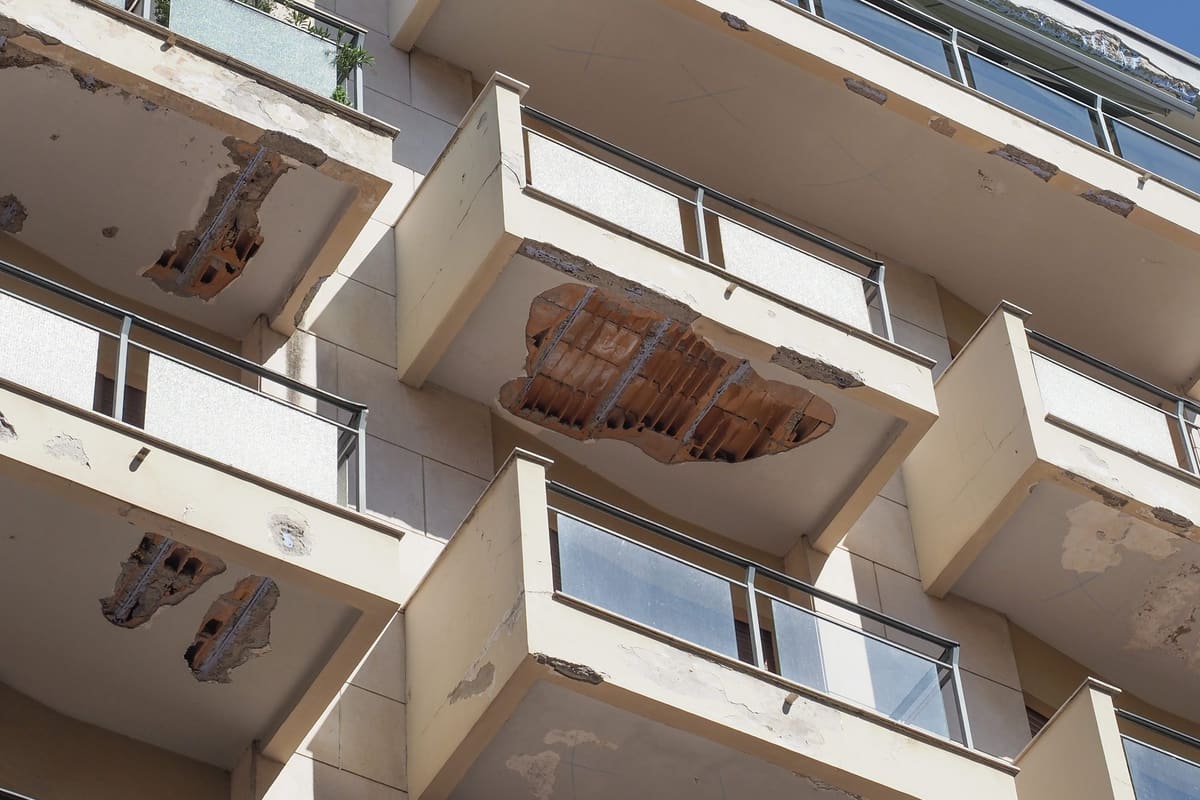
From the street, at first, you barely notice. Two researchers from Argentina’s CONICET, writing in the technical journal Cemento Hormigón, list what can be seen when reinforcement corrodes: rust stains, cracks or delamination in the finishes, and even pieces of material coming away. A fine, straight line along the edge of a balcony, or a brown streak running down the facade, is exactly that. And paint fixes nothing there, because the crack is being opened by the steel from inside: first the concrete is repaired and the reinforcement treated, and the painting comes last. What else the coastal climate does to a facade, and why two sides of the same block do not age the same way, is on our facade painting page.
If it fails
An unfavourable report is not submitted on its own. The Gerencia requires it to include “the photographs needed to identify the damage” and the “measurement and budget broken down by chapters and items of the necessary repair works”. From then on the community is obliged to carry out the works, and the clock is short: the licencia de obra, the building permit, has to be applied for “within a maximum period of three months from the submission of the report”. The deadline for starting and finishing the works is then set by the permit itself.
Three months does not go far in a community of owners: calling the general meeting, approving the work, deciding how it will be paid for and getting quotes. It pays to get moving as soon as the surveyor lets you know the result is going to be unfavourable, not once the report has already been registered. The itemised measurement helps: with it, quotes from different firms can be compared line by line.
When the works are finished, the Gerencia is notified with the final works report, with the stamped certificate of completion or with a new, favourable ITE. As for municipal costs, processing the ITE carries a fee of 30 euros if it is favourable and 50 if it is unfavourable, and the works permit pays the construction tax: 3.8% of the material execution budget (presupuesto de ejecución material).
For the works there are grant schemes from the City Council and from the Junta de Andalucía, the regional government, each with its own requirements, applied for through their rehabilitation offices. For paying the surveyor’s report, on the other hand, the Gerencia says there is no call for applications open at the moment.
If it is not submitted
Failing to submit it on time opens disciplinary proceedings: a fine of 3,000 euros, or 4,000 if the building is listed. If the community submits it after the first formal notice and within the deadline it is given, the fine drops to 600 euros, or 1,000 for listed buildings. Not doing it at all costs a good deal more than doing it late.
A favourable ITE is not good for ten years
The inspection is a snapshot of the building on the day it was done. The underlying obligation is a different one, and it does not expire: Andalusian law says owners have “the duty to keep them in conditions of safety, health, functionality, universal accessibility, energy efficiency, public decorum and any others required by law”. If a crack opens on the edge of a balcony the year after a favourable ITE, it has to be repaired, without waiting for the next inspection. On the coast, what is more, that crack will not wait: it lets in exactly what caused it.
Frequently asked questions
Is the ITE for my flat or for the whole building?
Is the ITE for my flat or for the whole building?
For the building. The by-law places the obligation on the owner and, in a building of flats and commercial premises, on the community of owners. A single owner does not put their own flat through the ITE: the community commissions it, and the report covers the structure, the facades, the roofs and the water supply and drainage networks.
Wasn’t it twenty years, not fifty?
Wasn’t it twenty years, not fifty?
It was under the previous by-law. The City Council website still carries a Gerencia FAQ PDF that talks about buildings more than 20 years old, but it is out of date: it gives the fee as the “2011 amount”. The by-law in force is the 2013 one, and under it the threshold is 50 years, or the building being listed.
What if the building is not in the city of Málaga?
What if the building is not in the city of Málaga?
Then your own town hall’s by-law applies, if it has one. Andalusian law allows each municipality, “by means of the corresponding by-law”, to mark out areas in which owners must have this inspection carried out “with the frequency that is established, and a minimum of ten years”. The dates and requirements in this article are Málaga’s; in Marbella, Torremolinos or Mijas you need to check each town’s own rules.
How much does the report cost?
How much does the report cost?
The surveyor’s fees are agreed freely with the community, so there is no official price. What is fixed is the municipal fee for processing it: 30 euros if it is favourable and 50 if it is unfavourable.
Does the ITE have to be stamped by the professional body?
Does the ITE have to be stamped by the professional body?
No: having the report stamped (visado) is voluntary, as it is for the final works report. What does have to be stamped is the certificate of completion, when the repairs require one.
Sources
- Gerencia Municipal de Urbanismo de Málaga, “Conservación e ITE”, with the FAQ for the by-law currently in force.
- Ley 7/2021, de impulso para la sostenibilidad del territorio de Andalucía, articles 144 and 145 (BOE, Spain’s Official State Gazette).
- Miguel Ángel Bermúdez Odriozola, “Corrosión de las armaduras del hormigón armado en ambiente marino: zona de carrera de mareas y zona sumergida”, doctoral thesis, Universidad Politécnica de Madrid, 2007 (PDF).
- María Beatriz Valcarce and Marcela Vázquez, “Corrosión en ambiente marino”, technical journal Cemento Hormigón (open-access abstract).
Quotations from Spanish-language documents are our own translations.
Has your building’s ITE come back with work needed on the facade? Send us the photos from the report and we will tell you which part is repair and which part is painting.