Blog · Facades and restoration
Salt deposits on walls: where they come from and why paint won’t hide them
Where the salt comes from, why it crystallises under the paint until it lifts it, and why the water has to be stopped before treating it.
7 min read
It shows up low down, at floor level or a hand’s width above, as a white powder that comes off on your fingers. It gets brushed off, painted over, and a few months later it is back in the same place, sometimes lifting the new paint with it. That powder is salt, and it does not come from outside: it is drawn out by the water passing through the wall.
That is why it cannot be painted out. Its path has to be cut, and to do that you need to know what the path is.
What we call salitre
In Spain this white bloom is called salitre. Strictly speaking, salitre is one particular salt, potassium nitrate: the table of building salts in a restoration course unit from the University of Granada lists it as “Nitro (salitre)”. On site, though, any white salt stain gets the name. The ones found on walls are, according to that same unit, mainly carbonates, sulphates, chlorides, nitrates and nitrites.
Mortar manufacturers call it efflorescence, and define it as “whitish stains that appear on the surface of certain materials, due to soluble salts, either present in the material itself or foreign to it”. In other words, the salt can come from the brick, from the mortar or from outside.
They also warn about something worth ruling out first: not every stain on a wall is salt. It may be dirt, or mould growing in the damp. If yours is dark and turns up in the coldest corner, that is a different story: anti-mould paint and its limits.
Three conditions at once
The efflorescence sheet from the Valencian Building Institute (IVE) says three things have to come together for it to appear:
- “Soluble salts in one of the elements making up the wall”.
- “Presence of moisture. The most usual is infiltrated moisture”.
- “Transport of the salts through the walls until recrystallisation takes place”.
The mortar manufacturers describe the journey: water “from rain, from the building work, from the ground, from watering” gets in through the pores, dissolves the salts on the way and carries them outwards. There, “as the water evaporates, they come to the surface, staining it”.
Of the three conditions, only one can really be removed. The salt already in the material is there to stay: about it, the IVE sheet admits, “it is almost impossible to act”. What can be stopped is the water.
Where the water comes from
The University of Granada unit sums it up as two sources: “water from the subsoil, and rainwater”. The first rises by capillary action, through the fine pores of brick and mortar, the way coffee climbs up a sugar cube. The second gets in by gravity, through joints, copings and cracks. It adds a third in very damp settings, condensation, which wets the surface but gets in far less.
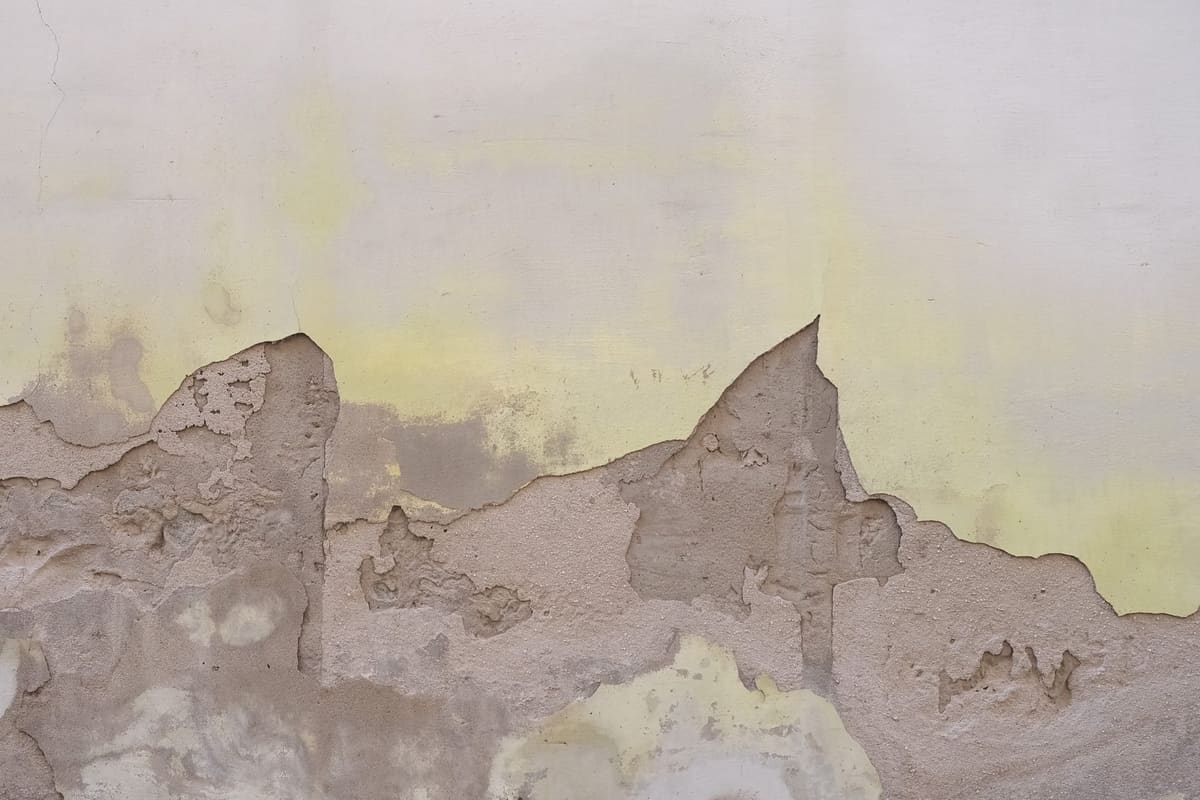
What surprises most is how far the water from the ground climbs: in walls with rising damp, it says, “heights of several metres are perfectly normal”. And it does not leave its mark just anywhere. Just above the wettest band at ground level comes the worst damage, “with granular disintegration and sanding of stone and mortar, scaling of renders, loss of the paint film”, and that is where most of the salt collects.
An inside wall behaves the same way, with the skirting board in place of the plinth. The height the stain reaches varies, according to the same unit, between parts of the same building: inside versus outside, or the north face versus the south. Knowing which water is wetting the wall is the first step, because each one is stopped in a different way. How to tell them apart, and why only rainwater is solved by waterproofing from outside: facade waterproofing.
Why paint won’t hide it
Water rises with its salt dissolved until it evaporates, and the salt stays wherever the water evaporates. If the water reaches the face of the wall, the salt comes out and shows as white powder. If it evaporates sooner, the salt crystallises inside, close to the surface. The University of Granada unit adds that, in a wall with mortar and paint, the salt can crystallise right “between the mortar and the paint layer”.
The salt that lifts the paint
Water rises through the pores of the wall, dissolving salts from the brick, the mortar or the ground on the way.
When it reaches the surface, the water evaporates and the salt stays behind. Under the paint it has nowhere to go, so it crystallises right underneath.
The salt grows as it crystallises and pushes the film from inside: it blisters, splits and the white powder comes out.
That is the problem. Salt that comes out on the face is almost harmless: according to the same unit, when it crystallises on the surface its mechanical effect “is nil”. Salt that stays underneath is not. The IVE sheet explains that “the crystallisation of any salt involves an expansion of up to 35%, which means a push on the layer of material covering the cavity which, if it is very thin, ends up detaching it”.
A paint film is a very thin layer. Painting over salitre does not stop it: it puts a lid on it, and the salt starts growing underneath. That is why new paint blisters and falls off exactly where the stain was. If it is the render that has come loose and not just the paint, repairing the facade comes first.
On the coast, the salt comes and goes with the air
By the sea, salt does not only rise from inside: the breeze also deposits it on the face of the wall. What that salt does to a seafront facade is covered on our facades page. And there is a second reason why coastal salitre never seems to sit still.
Every salt has a level of air humidity above which it dissolves. The University of Granada puts it like this: “As long as the RH stays above the HReq for a given salt, the solute will remain in solution or the salt will dissolve. When the ambient RH is lower than the HReq, the salt will precipitate”. For common salt, the kind the sea breeze carries, its table puts that line at around 75% relative humidity.
Every time the air crosses that line, the salt changes state: it dissolves when the air fills with moisture and crystallises again when it dries. These cycles, the unit says, “are common on a daily scale”. Each turn is another push against whatever lies on top.
Before painting, in this order
The IVE sheet is clear about the most common mistake: on a facade with efflorescence, the damage “should never be repaired without first finding the cause (damp) that produced it”. And it gives the order:
- Stop the water. Deal with the damp bringing the salt. It is the only step that keeps it from coming back.
- Remove the salt. Once the water is stopped, clear off what has come out with natural, chemical or mechanical cleaning.
- Protect. Surface stabilisation treatments and waterproofing, so the damp does not return.
The data sheet of a clear anti-salt treatment sets out the preparation: wash the surface “with plenty of water to force the precipitation of the encapsulated salts” and leave it to dry for at least 24 hours. It asks for a dry, sound, well-bonded surface; if it has turned sandy or dusty, brush it down and consolidate it first. It is not applied in direct sun or on a wall heated by the sun. And the manufacturer itself describes it as being for stains “caused by capillary absorption of water carrying salts from the wall”. In other words, it is designed for what the water leaves on the wall; the water is stopped separately.
With the water stopped, the salt cleaned off and the wall dry and sound, it can be painted. Before that, any paint is just one more lid.
Frequently asked questions
Is salitre the same thing as damp?
Is salitre the same thing as damp?
It is the trace damp leaves behind. For it to appear there have to be salts in the wall, water to dissolve them and a route for that water to reach the surface. Without moisture, the salt stays put inside the material and cannot be seen.
Why does it come back after cleaning?
Why does it come back after cleaning?
Because cleaning removes the salt that has already come out, not the salt still inside nor the water bringing it. As long as water keeps getting in, it will keep carrying salt to the face of the wall. And as for the salts in the brick or mortar themselves, the IVE sheet admits that “it is almost impossible to act”.
Can it be fixed with an anti-salt treatment and a coat of paint?
Can it be fixed with an anti-salt treatment and a coat of paint?
The treatment comes after, not before. The IVE repair sheet puts stopping the damp first, then cleaning off the salt and finally protecting. And the data sheet of an anti-salt treatment asks for a dry, sound surface washed beforehand with plenty of water, with at least 24 hours of drying.
Is it dangerous for the house?
Is it dangerous for the house?
The bloom on the outside, on its own, hardly ever is: for mortar manufacturers it is usually “an aesthetic problem”. What does the damage is the salt that crystallises inside, close to the surface, which turns mortar to sand, flakes the render and lifts the paint. And the water bringing it may be causing other trouble too.
Why does it appear on a brand-new wall?
Why does it appear on a brand-new wall?
On freshly finished brickwork it is almost unavoidable, according to the IVE, because every brick carries some soluble salt, and fresh mortar also reacts with the air and leaves calcium carbonate on the surface. It is known as “construction efflorescence”. The treatment’s data sheet also asks for a mineral surface to be at least 28 days old before treating it.
Sources
- ANFAPA (Asociación de Fabricantes de Morteros y SATE), «Cómo evitar las eflorescencias en morteros».
- ANDIMAC, Consejos Pro 41, «¿Qué debo saber sobre las eflorescencias de fachada?», with the sheet from the Instituto Valenciano de la Edificación (IVE), published by Grupo Puma.
- Antonio García Casco, University of Granada, «Tema 10: Efectos debidos a las sales solubles» (Restauración de Materiales Pétreos).
- Graphenstone (IEdiSA), data sheet for the anti-salt treatment «Neutralysal Premium» (January 2018 version).
Quotations from Spanish-language documents are our own translations.