Blog · Decorative painting
Tadelakt: the lime finish closed with stone and soap, and when it can take a shower
The lime finish burnished with a stone and closed with soap: what makes it water resistant, what wall it needs, and what a manufacturer's data sheet and a job in the Axarquía say about using it in a shower.
7 min read
In Marrakech it was used to line baths and cisterns: lime, polished with a stone until it shines and closed with black soap, on walls that had to stand up to water. That is tadelakt, and its story runs through here: the leaflet for a workshop by the Andalusian Institute of Historical Heritage says the technique “was practised in Al-Andalus around the 11th century” and that, after the Reconquista, the craft crossed the Strait of Gibraltar with those who left for Morocco.
Today it is also sold as a powder, ready to mix with water, and there are recent jobs an hour from the coast, in the Axarquía. What is worth knowing before you have it put on is where its water resistance comes from, what wall it needs and why a manufacturer and a pair of applicators disagree about showers.
What tadelakt is
A lime finish for walls that is finished off with a stone and with soap. According to the Andalusian leaflet, the master craftsmen of Marrakech developed it thanks to a local limestone that gave a lime “with a hydraulic property particularly suited to rendering baths and cisterns”.
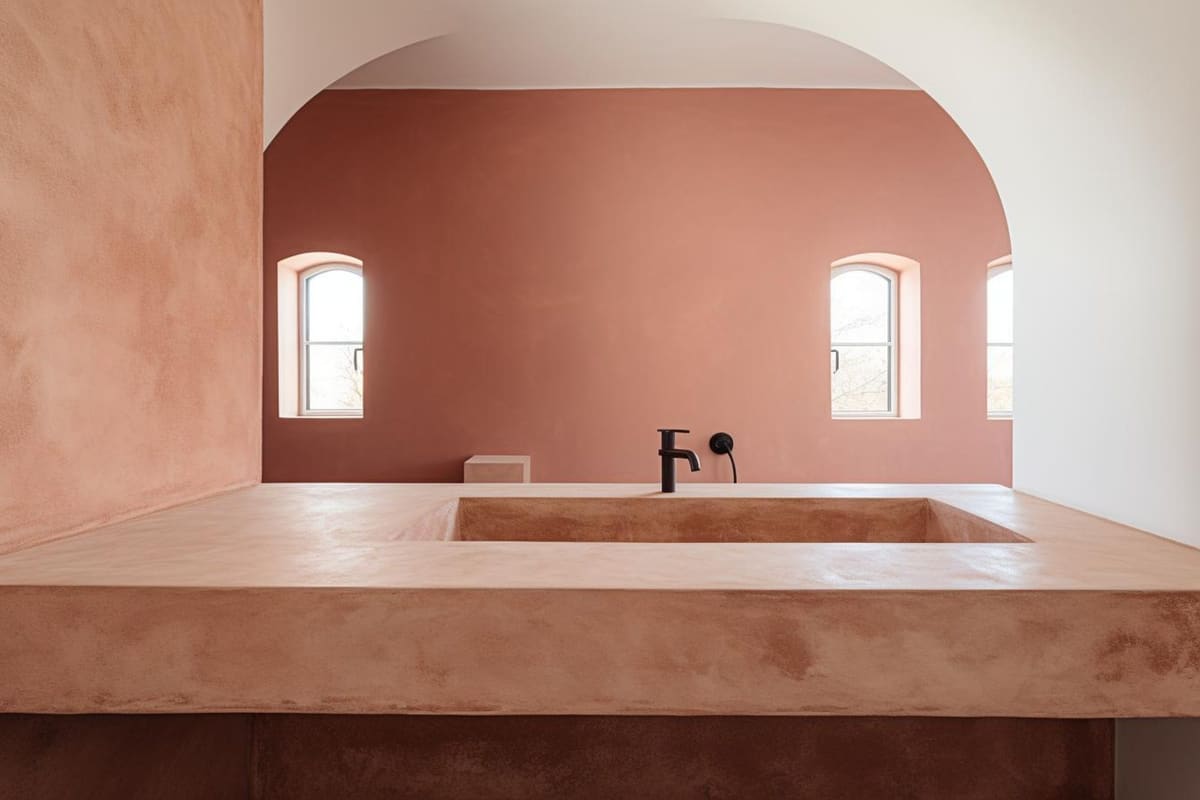
Today’s versions follow the same line. A German manufacturer’s data sheet declares hydraulic lime, quartz sands, marble powder, clay and methylcellulose, and describes it as a mineral plaster for water resistant surfaces “in traditional Moroccan style”. A paper presented in 2026 at the Spanish building surveyors’ convention describes a job in Canillas de Aceituno, in the Axarquía, where the mix was made with natural hydraulic lime, lime putty from Estepa and dolomite from a local quarry. Its authors put it bluntly: “there is no need to import lime from Marrakech to get authentic results”.
That is where the first difference from Venetian plaster comes in. Venetian plaster is burnished with the trowel, in very thin coats, and its shine comes from pressing the lime with steel. Tadelakt is pressed with a stone and, above all, treated with soap while the lime is still fresh, and that is what changes how it behaves with water. The rest of the family is in the types of stucco.
The stone and the soap
The manufacturer’s data sheet calls for two layers, each “only slightly thicker than the grain size”, approx. 1–1.5 mm, with both layers and the first soaping done on the same day. The first is not smoothed or polished, and must not dry out completely before the second. The second is: it is burnished with the stone in small circles and with light pressure “until all pores are closed and gloss is achieved”. In the Axarquía the final coat was 2 mm, in two coats laid “fresh on fresh” and burnished with agate and basalt stones.
Then comes black olive oil soap, diluted in water, which is spread on and polished again with the stone. The Axarquía paper explains what happens next: the fatty acids in the soap react with the lime and form calcium stearates, insoluble salts that “make the surface water repellent without sealing it, allowing vapour to diffuse but stopping liquid water from getting through”. The German data sheet says the same: the reaction is “between the soap and the fresh lime”.
The stone and the soap
Freshly laid, the lime has open pores. It goes on in two thin coats, both on the same day, over a base that is also lime.
The stone closes the pores: it is worked in small circles with light pressure, tightening the surface by friction until it shines.
The soap does the rest: it reacts with the lime and forms a salt that does not dissolve. Liquid water runs off; vapour from the wall still gets out.
The timing of each step is not set by the clock. Both sources say it depends on moisture: the data sheet, on the water left in the surface, on how absorbent the base is and on the climate; the Axarquía job allowed about twelve hours for the coat to firm up before burnishing, “variable according to the relative humidity”. On the coast, on a day of levante (the easterly) or of terral (the hot wind off the land), those hours change, and it is the applicator who reads them on the wall.
Can it take a shower? It depends who you ask
Here the sources do not agree, and it is better to know that before than after.
- The manufacturer’s data sheet is cautious. It says tadelakt is water resistant and that the soap makes it water repellent, but that it is “not completely impermeable”. It suits “splash water areas” and is “not recommended for showers, wash basins and bathtubs”. It warns that areas left wet for longer absorb water and darken until they dry, and that it has to dry out completely once a day: if it stays moist for too long, matt areas, discolouring and fungi might appear.
- The Axarquía job is optimistic. Its authors tested it with water directly: the water “runs off the surface” without the lime absorbing it, and they conclude that its water resistance is suitable “for use in showers, washbasins or surfaces exposed to frequent moisture”.
They do not contradict each other as much as it seems. The same paper ends by saying that tadelakt’s most frequent failures (cracks, loss of the water-repellent effect, a finish without compactness) are almost always workmanship errors, and that the result cannot be separated from whoever applies it. The data sheet also warns of this, calling it “a very demanding craft technique”; but a manufacturer selling a bag to whoever buys it cannot count on that pair of hands, and a team that mixes and burnishes it on site can. In a shower used every day, the question is not only whether tadelakt holds up, but who is going to apply it and whether it will be looked after. That is more than is asked of Venetian plaster, which in a bathroom stays out of the spray, as we explain on its page.
What wall it needs
According to the data sheet, the best base is brickwork with at least 1.5 cm of hydraulic lime plaster or lime-cement plaster, untreated and solid. It can also go over gypsum, concrete or plasterboard and cement fibre boards, but only after a primer and an intermediate coat, and on boards with a glass fibre mesh over the whole surface. The base has to be dry and rough, never smooth, and edges are rounded off: no corner trims.
In a renovation you usually find something else, and the Axarquía paper focuses on exactly that: the house in Canillas de Aceituno was more than three centuries old, but inside, its walls were cement mortar. To make the lime grip, they ground back the cement to open its pores, gave it a hydraulic lime bonding coat without resins, and a 5 mm levelling coat before the tadelakt. Where that coat came out thicker than intended, hairline cracks appeared as it cured. In other words, in a renovated bathroom much of the work does not show: it is underneath.
How to look after it
What surprises people most about tadelakt is not how it is made, but how it is cleaned. The manufacturer’s data sheet says to clean it only with water and a little Marseille soap, to wipe away water splashes with a soft cloth after every use so that no limescale is left, and to use no other household cleaning agents, scouring sponges or microfibre cloths. In wet areas it has to be soaped again every one to two months. It is not grease repellent, and creams, cosmetics or food can leave stains on it that will not come out. Nor does it stand up to acids.
In a holiday let, that list has to be handed to whoever cleans between guests, because the usual cleaning products are ruled out. And it takes patience at the start: according to the data sheet, it reaches its final hardness after about six months, and for the first three it has to be treated gently. It is the same logic as any lime finish, which keeps hardening after it is dry; we explain it in lime paint.
One more detail on which the two sources do not agree either: wax. In the Axarquía the finish was protected with beeswax and carnauba wax; the data sheet allows waxing for a higher gloss, but only on a surface that has already been soaped and never where water splashes, because of the risk of white stains. On a shower wall, it is best to ask before. If what you are after is a continuous wall with no joints and the upkeep puts you off, compare it with microcement.
Frequently asked questions
What does “tadelakt” mean?
What does “tadelakt” mean?
According to the leaflet for the workshop run by the Andalusian Institute of Historical Heritage in 2014, in Berber it means “to caress, to massage”. That is what is done to the wall at the end: it is burnished and massaged with a smooth pebble coated in black soap until the surface is soft and glossy.
Can it go on a floor?
Can it go on a floor?
The manufacturer’s data sheet we read says no: tadelakt is not suitable for floors. Nor for surfaces that stay wet all the time. It is a wall finish.
What about outside, on a terrace or a facade?
What about outside, on a terrace or a facade?
The same data sheet limits it to interiors, and the Axarquía job described above is indoors too. For an outside lime wall on the coast there are other finishes designed for the job, and we cover them in our article on the types of stucco.
Tadelakt or microcement in a bathroom?
Tadelakt or microcement in a bathroom?
Both give a continuous wall with no joints. The Axarquía paper compares them: in a wet area microcement needs a polyurethane sealer which, according to its authors, lets much less vapour through, whereas in tadelakt what repels water is in the lime itself. On the other hand, they conclude that tadelakt usually costs more, because it takes more skill and tighter control of the timings.
If it gets scratched or marked, can it be repaired?
If it gets scratched or marked, can it be repaired?
Yes, but it will show. The manufacturer’s data sheet says to cut the tadelakt around the damaged area and redo it with the same material, and warns that the repair will be visible later on, as one more mark of age. On the Axarquía job, the small cracks that appeared while it cured were consolidated with potassium silicate before waxing.
Sources
- KREIDEZEIT Naturfarben, “Tadelakt. Productinformation”, article no. 3203 (12 August 2026).
- M. J. Bustos Béjar and J. Moral Abásolo (Alqatifa), «Tadelakt: técnica tradicional de revestimiento continuo y su aplicación en obra contemporánea en la Axarquía», CONTART Alicante 2026, XI Convención Internacional de la Arquitectura Técnica (RIARTE repository of the Consejo General de la Arquitectura Técnica de España).
- Instituto Andaluz del Patrimonio Histórico and Asociación Cultural Hornos de la Cal de Morón, leaflet for the «Taller de formulación y aplicación de la técnica tradicional del Tadelakt» (2014).
Quotations from Spanish-language documents are our own translations.