Blog · Decorative painting
Lime paint: advantages, drawbacks and how it is applied
Lime paint according to two current data sheets: mould, the surface, curing time and rubbing.
8 min read
Lime is what has kept the villages of Andalusia white, and that is not a figure of speech: in 2011 UNESCO added the revitalisation of the traditional know-how of artisan lime-making in Morón de la Frontera to its list of good practices for intangible heritage. The agreement from the Andalusian Historical Heritage Institute that recalls this also speaks of a lime heritage that is “for now, fallen out of use”.
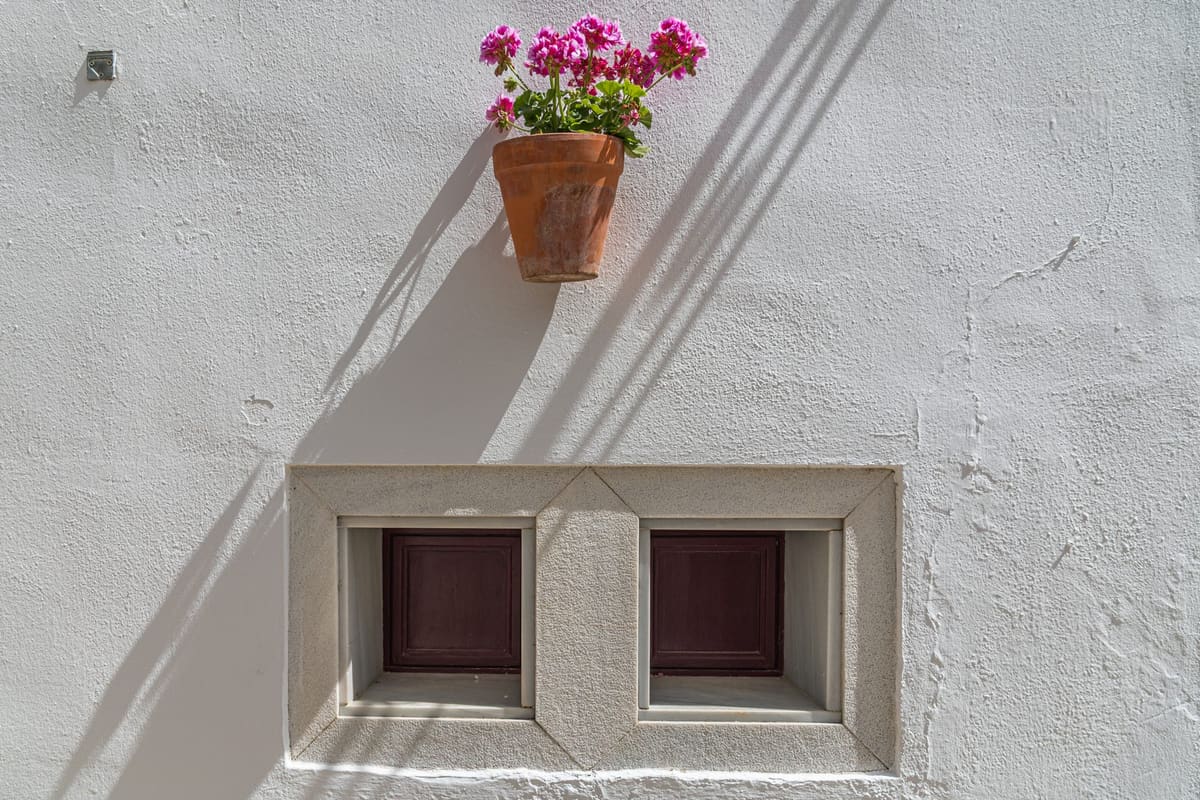
And yet lime paint is still sold, now in tins and with a technical data sheet. We have read two current ones in full, from two manufacturers, to separate what is true from what simply gets repeated: what it does, what wall it needs, how long it takes and what it cannot take.
What lime paint is
A paint whose binder is lime instead of a resin. The first of the two data sheets says so with the standard in front of it: “Natural wall paint based on selected pure air lime CL 90-S, in accordance with standard EN 459-1”. The second, from a cement and mortar manufacturer, describes it as a paint “based on lime, extra-white aggregates, mineral pigments and additives”. Both give a very matt, mineral-looking finish, and both are suitable for inside and outside.
Nor is it a lime plaster, even though they share the material. Lime plaster contains marble dust, is applied with a trowel, layer upon layer, and is worked until it has a sheen or a grain. The paint goes on with a brush or roller and stays a thin film. What happens to lime when it is burnished is on our Venetian plaster page, and the types of plaster, in their own article.
What it does: lets vapour out and makes life hard for mould
The underlying reason for choosing lime is that the wall breathes. The first data sheet lists it with pride among its properties, and the second measures it: its vapour transmission class is the high one, with an equivalent air thickness below 0.14 m. Put another way, the coat of paint barely holds back the vapour coming out of the wall. In an old house with thick walls, or on a traditionally limewashed facade, that is exactly what you want: for that vapour not to get trapped behind it.
The mould part has a chemical explanation: lime is highly alkaline. The first data sheet gives a pH of between 12.95 and 13.05, and sums it up like this: “By its nature it gives the film anti-mould protection”. The second, however, covers itself: there are so many species of mould and so many climates that its additives “cannot guarantee the total disappearance or the non-proliferation over time of certain plant microorganisms”. Neither of them promises to clean off mould that is already there. Why it comes back to the same corner whatever you paint it with: when painting is enough and when it is not.
What it needs: a mineral wall and a calm day
Lime grips on what resembles it. The first data sheet recommends it “on lime and cement-lime renders” and rules out the rest in one sentence: “Not suitable for application on gypsum plasters, plaster of Paris and plasterboard”. The second asks for lime-based plasters. Both want the wall clean, with no dust or grease, and both mention salt: one asks for the surface to be free of saltpetre, the other of salt efflorescence. On a facade near the sea, the crust of salt left by the breeze is brushed off before, not after.
On old paint, the data sheets disagree. The second forbids it outright: “Do not apply over washable or synthetic paints”. The first accepts a wall that has already been painted if the previous paint is “in good condition and well adhered”. There is no general answer: the data sheet of the product you are going to use has it.
And the weather matters more than with an emulsion. The first data sheet: do not paint below 7 °C, or above 80% relative humidity, or in rain, or “during the hottest hours”. The second is stricter: between 5 and 30 °C, with humidity below 75%, without direct sun on the wall and without strong wind. Here on the coast, that rules out the sunny hours on a south-facing facade and the days of levante, the east wind, or a strong poniente, the west wind.
Dry in half an hour, and not finished
What surprises people most about lime is the clock. According to the first data sheet, at 20 °C it is touch dry in 30 minutes and ready for the second coat after three or four hours. But full drying, in the same table, takes 15 to 20 days.
Dry in half an hour, finished in weeks
Touch dry in half an hour. That is what the first data sheet says, at 20 °C. Not marking your finger does not mean it has finished.
Three or four hours later, the second coat. Both data sheets ask for two coats, and one of them wants them crossed: if the first goes top to bottom, the second goes side to side.
And fully dry after 15 to 20 days. The wall already looks finished, but it is not. The second data sheet asks for it to be protected from rain, fog and high humidity over the following days, without saying how many.
Those weeks are not a laboratory detail. The second data sheet asks for the wall to be protected “during application and during the following days” from rain, high humidity and fog, because “‘snail trail’ effects, erosion, stains, colour changes” can appear. Here, where a humid night or a morning sea fog can arrive without warning, a limewashed facade is planned by looking at the forecast for several days, not just for the day of painting.
The drawbacks, plainly
- It does not stand up to rubbing. The second data sheet puts it in class 5 for wet scrub resistance under the European standard, the last of five, and spells it out: the paint “does not withstand abrasive stresses on the surface without its appearance being altered”. For a wall that will be wiped down often, choose something else. Which class to ask for in each room is covered in painting walls and ceilings.
- Touch-ups show. “Continuing the painting or touching it up afterwards can lead to an obvious discontinuity in colour”, says the same data sheet. A section of wall is started and finished in one go, with material from the same batch.
- The colour depends on the day. Because it is mineral, the final shade “can depend greatly on the weather conditions and the type of surface”, and the data sheet recommends a test first. There are colours: one comes in white and in its own colour chart; the other, in the RAL and NCS charts. What there is not is a guarantee that it will come out the same as the printed sample.
- It is not the most protective paint. The second data sheet warns that its paint cannot be considered a product “with a high degree of protection” and recommends not using it on very exposed, poorly protected surfaces. A seafront facade with no eaves, taking the full force of the storms, needs thinking about twice.
Nor do the two data sheets look alike in how they deal with liquid water, the rain: in the same test, the first declares an absorption of 0.09 kg/m²·h½ and the second gives it as high, above 0.5. Very different behaviours fit under the same name, and that is why, rather than “lime paint”, what you need to compare is the data sheets.
And indoors?
Both are also declared for interior use, and indoors they have their place: a bedroom or living room with lime or cement-lime walls, a country house, a wine cellar, a ceiling nobody touches. The deep matt and the texture of a limewashed wall are its charm. What makes no sense is putting it on a plasterboard partition, which the first data sheet rules out, or on the hallway wall that gets wiped every week.
Frequently asked questions
Can you paint with lime over emulsion paint?
Can you paint with lime over emulsion paint?
It depends on the lime paint: on this point, our two data sheets contradict each other. One forbids it: “Do not apply over washable or synthetic paints”. The other accepts a wall that has already been painted if the previous paint is “in good condition and well adhered”. Before you buy, the answer is on the data sheet of the tin you are going to use, not in a general rule.
Does lime paint get rid of damp in the wall?
Does lime paint get rid of damp in the wall?
No. It lets vapour out, which is not the same as drying a wall. The second of our data sheets says not to apply it on damp walls and to avoid it where damp rises from the ground by capillary action, because the water building up inside can lift the finish. If the wall has damp coming from somewhere, that gets fixed first.
How many coats of lime do you need?
How many coats of lime do you need?
Two, according to both data sheets. One asks for them to be crossed and thinned with water, the first a little more; the other, undiluted. Between one and the next, a few hours: three or four on one data sheet, four to six on the other, and in extreme conditions, until the first is completely dry.
Can a lime-painted wall be washed?
Can a lime-painted wall be washed?
Not much. One of the data sheets puts it in class 5 for wet scrub resistance under the European standard, the lowest, and warns that it does not stand up to rubbing without its appearance changing. In a hallway or a children’s room, where the wall gets wiped down, it is not the right paint.
What is jabelga?
What is jabelga?
“Jabelga” is what Andalusians call limewashing: whitening a wall with lime. It is lime paint as it always was, before it was sold in tins, and it is what has kept the villages of the south white. The tinned kind also contains aggregates, pigments and additives, which is why it comes with a data sheet telling you how to apply it.
Sources
- Pinturas Isaval, ficha técnica 2299, «Caoval. Pintura a la cal» (technical data sheet, version 15, June 2026).
- Holcim España, ficha técnica de «TectorPaint 2003 Cal» (technical data sheet, November 2025 revision).
- Instituto Andaluz del Patrimonio Histórico, convenio con la Asociación Cultural Hornos de la Cal de Morón para las actividades formativas de 2023 (agreement with the Morón lime kilns cultural association on its 2023 training activities).
Quotations from Spanish-language documents are our own translations.