Blog · Decorative painting
Types of stucco: how to recognise each one by eye and by touch
Lime or resin, then the grain: the map of stucco finishes from what their data sheets say, and how to recognise the one on your wall.
8 min read
The word stucco (estuco in Spanish) covers things that look nothing alike. In everyday speech, a stuccoed wall is almost any smooth wall with a bit of sheen. In the trade, stuccoing means spreading a paste with a trowel in thin layers, and that paste can be lime with marble dust or a filled resin sold under the same name. To sort it out, we went to the data sheets of four stuccos from three manufacturers: the map comes from what they say, not from what a catalogue says.
Two questions sort out all the types: what it is made of and how it has been worked. The first decides where it can go; the second, how it looks and how it feels under your palm.
What it is made of: lime or resin
A lime stucco is just that: lime and ground marble. Naturclay’s data sheet for its Venetian plaster sums it up in one line: “Air Lime Stucco CL90-S [according to EN 459-1], marble dust and 100% natural additives”. Revetón’s data sheet for its marmorino describes a “fat lime putty obtained from burning air lime, slaked, long matured and perfectly slaked”, with colour earths and marble dust.
The other group is the synthetics: pastes that go on the same way and can carry the same name. Isaval’s data sheet 1371 is headed “Estuco veneciano” and, just below, “Estuco sintético” (synthetic stucco). It is not a trick, but it does change what you can do with it, and its data sheet says so plainly: “Exclusively for interior use”. How to tell them apart on the wall, and why they age differently, is explained on our Venetian plaster page.
The types, by grain and by how they are worked
Among the lime stuccos, what separates one type from another is mainly the size of the ground marble and how the final coat is worked. With the data sheets in hand, these are the three most asked for.
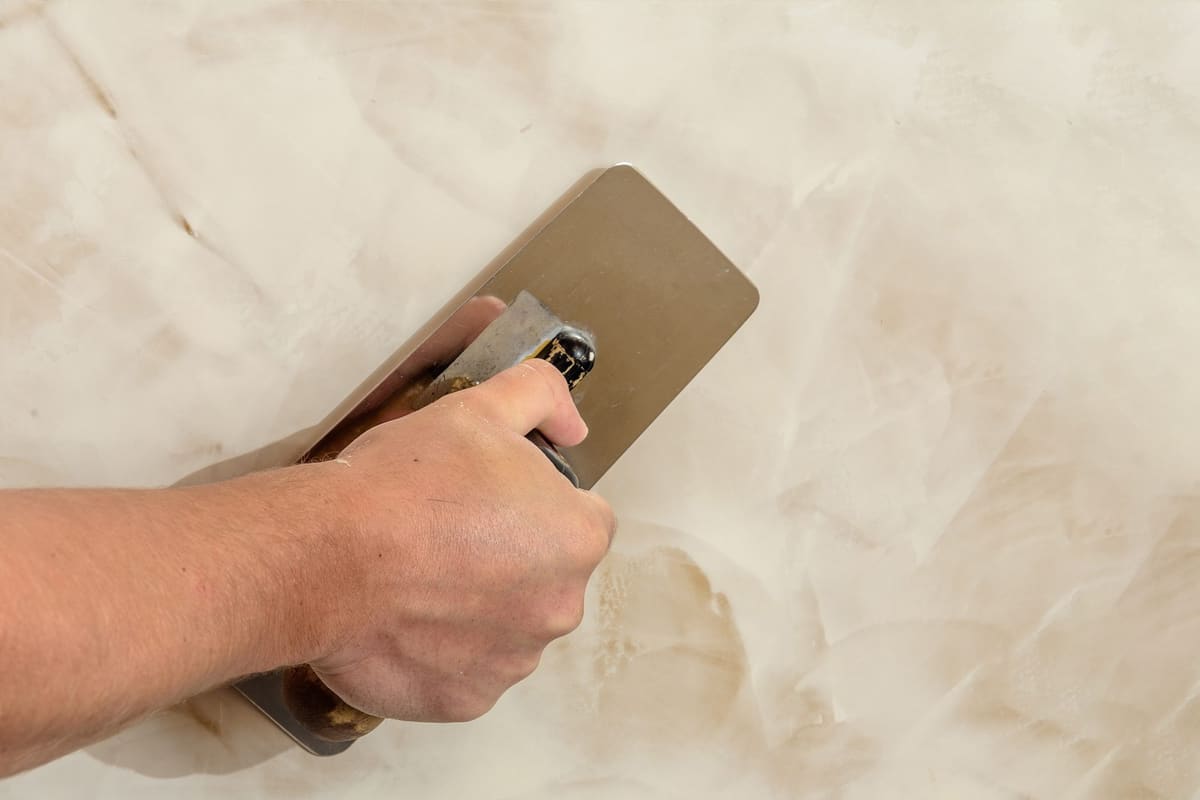
- Venetian. The finest grain: Naturclay’s data sheet gives a “Grain size range 0-100 microns”, that is, from zero to a tenth of a millimetre. It goes on in two or three very thin coats and is worked with the trowel until the surface is smooth and glossy, with “clouding and glazes”. To the eye, light slides across the wall and leaves patches of a lighter tone and a darker one. To the touch, your fingertip finds no grain.
- Marmorino. The same family, with a different finish. Revetón’s data sheet calls it a stucco “with a fine granular appearance” reminiscent of “old floated renders based on lime and natural pigment earths”. To the eye, more matt than Venetian, with a stone-like grain. To the touch, you can feel the grain, fine and even.
- Travertine. It imitates the stone of that name, with its pores and veins: Isaval’s data sheet talks of an “effect similar to the ancient Roman TRAVERTINE marble”. Its trick lies in the second coat. When it has hardened on the outside but not yet dried, the surface is scraped “horizontally from right to left with the cutting edge of the trowel”, smoothed gently and, once dry, coloured and protected with a glaze. To the eye, horizontal bands with scraped areas. To the touch, grooves.
The synthetic mainly imitates the first. Isaval’s data sheet describes its finish as “Smooth, polished and glossy” and its technique as trowel work in “very thin layers of product in equidistant spaces”, which are rubbed after half an hour to bring up the shine. To the eye it looks very like lime Venetian plaster; the difference is in the material, not in the pattern.
Thickness: why some need a perfect wall and others do not
There is a difference between the types that does not show in catalogue photos and that decides a good part of the work: how thick each stucco is. The lime Venetian data sheet talks of layers a tenth of a millimetre thick. The travertine one calls for between two and three millimetres in the first coat alone, and explains what for: it “serves as a smoothing layer for the surface”.
How thick each stucco is
Three layers of a tenth of a millimetre. Those of lime Venetian plaster, according to its data sheet: about 0.1 mm each, in two or three coats. The whole finish, once done, does not reach half a millimetre.
Between 2 and 3 mm, and that is only the first. The base coat of travertine is the one that levels the wall. The second goes on top: the one that is scraped with the edge of the trowel.
One follows the wall; the other covers it. A few tenths of a millimetre leave no thickness to hide anything, which is why Venetian plaster needs a smooth wall before starting. Travertine brings that thickness with it.
A few tenths of a millimetre leave no thickness to hide anything, which is why the Venetian data sheet requires old renders to be left “suitably smoothed” beforehand, and even advises a first coat of marmorino in the same colour. Travertine does that job with its first coat. It is one of the reasons why two quotes for “stucco” on the same wall may look nothing alike: they are not always talking about the same preparation work.
Outdoors, on the coast
In Andalusia, lime is not a fashion: it is what has covered the facades of the white villages for centuries. Lime stuccos carry on that line, and of the four we have read, the three lime ones are declared for interior and exterior use. Isaval’s travertine data sheet goes further and calls it “Ideal for exterior facades of villas and historic buildings”.
What they have in their favour outside is that they let water vapour through. The data sheets measure it with the μ factor, the water vapour diffusion resistance: the lower it is, the more the wall breathes. Naturclay’s Venetian data sheet gives less than 6, and Revetón’s marmorino 12, with a structure that is “highly permeable to water vapour”. On a wall that takes on moisture, you want the outer layer not to trap it.
And what they ask for outdoors, here, makes itself felt. The lime Venetian data sheet says not to apply it “in strong wind, direct sun, rain or with a risk of frost in the following 48h”, with relative humidity below 80%, and to protect it from sun, wind and rain for the first 15 days while it carbonates. On the Costa del Sol that means choosing between a day with the levante or the poniente blowing — the easterly and westerly winds — and a calm one, and leaving the summer for indoor work. The same data sheet also calls for “interstitial salt encrustations” to be removed from the surface: on the seafront, the salt the breeze leaves on the wall is cleaned off first, not afterwards.
How to recognise the stucco you already have
If you are renovating a house with stucco and do not know which one it is, the wall will tell you, with a torch and the palm of your hand. Hold the light right against the wall, almost raking, and look at the reflection.
- Deep sheen, no grain to the touch: a Venetian, lime or synthetic.
- Matt or satin, with a fine grain you can feel: a marmorino or a similar medium-grain stucco.
- Horizontal bands with pores: a travertine.
- Relief in drops or in flattened blobs: that is not a stucco, it is gotelé, the spattered texture found in so many Spanish flats, and its types are recognised differently: the types of gotelé.
Telling lime from synthetic takes one more step, and when it comes to choosing a stucco for a new wall, what matters most is the light it gets. How a finish changes under raking light, head-on light and at night is explained in decorative painting.
Frequently asked questions
What does stuccoing a wall mean?
What does stuccoing a wall mean?
Covering it with a paste applied by trowel, thin layer upon thin layer, to leave it smooth or with a decorative finish. Unlike paint, which is rollered on and leaves a film, stucco carries a filler — marble dust, in the lime ones — and is worked with the tool until it has the look you are after: shine, grain or pores.
Can you stucco over a painted wall?
Can you stucco over a painted wall?
It depends on the stucco, and its data sheets say so. The one for the lime Venetian plaster we read says not to apply it over “old paints or smoothing coats”: they have to be removed to leave a porous base. The one for the synthetic, on the other hand, accepts old paint if it is firmly attached, after dulling the glossy areas so that it grips. If the paint is flaking off, it has to come off in both cases.
How long does stucco take to dry?
How long does stucco take to dry?
Each coat takes as long as its data sheet says. For lime Venetian plaster, about 12 to 24 hours, “depending on the weather conditions”. For travertine, three hours to be touch-dry and 24 before it can be sanded. And if it is lime and goes outside, there are also the fifteen days during which it has to be protected from direct sun, wind and rain while it carbonates.
Can a stuccoed wall be washed?
Can a stuccoed wall be washed?
Not all of them. The data sheet for the synthetic Venetian says it in capitals: “STUCCO is not washable”. For the lime ones, the Venetian data sheet recommends, as an option, a coat of wax to protect it, which also gives it more shine. Before scrubbing a mark, it is worth knowing which one you have and what it was finished with.
Which stucco can go on a facade?
Which stucco can go on a facade?
Of the four we have read, the three lime ones: travertine, marmorino and lime Venetian plaster are all declared for interior and exterior use. The synthetic one is ruled out by its own data sheet: “Exclusively for interior use”. On the coast, outdoors, as well as choosing well you have to choose your moment: no strong wind, no direct sun and the wall cleaned of salt.
Sources
- Pinturas Isaval, data sheet 1371, “Estuco veneciano” (synthetic stucco).
- Pinturas Isaval, data sheet 2206, “Estuco travertino” (decorative lime stucco).
- Naturclay, data sheet for “Estuco veneciano Grassello”, published by Biodecora.
- Revetón, data sheet for “Classical Estuco Marmorino 0,8”, in CYPE’s Generador de Precios.
Quotations from Spanish-language documents are our own translations.