Blog · Interiors and prices
Painting wooden doors: sand, prime or strip, and the roller that leaves the door smooth
Before the enamel, what is already on the door: when sanding is enough and when it has to come off, the test that avoids surprises, the primer and the two rollers that leave the door smooth.
6 min read
A door looks like the easiest thing in the house to paint: a small area, flat, within reach. And it is one of the things that turns out worst when it is rushed, because it is handled every day and because any brush or roller mark shows in the low light from a window.
We have read the data sheets for a water-based enamel and two primers to explain what really decides the result: what is already on the door and how the paint goes on.
First: what is already on the door
Before choosing the tin you have to look at the existing finish. The data sheets agree on the starting point. If the old paint is in good condition, one asks you to “sand to take the shine off, degrease, remove the dust” and the other says that “sanding the surface will be enough”. If it is in poor condition, both say it has to go: “If the old paint is in poor condition it must be removed and you proceed as for new surfaces”.
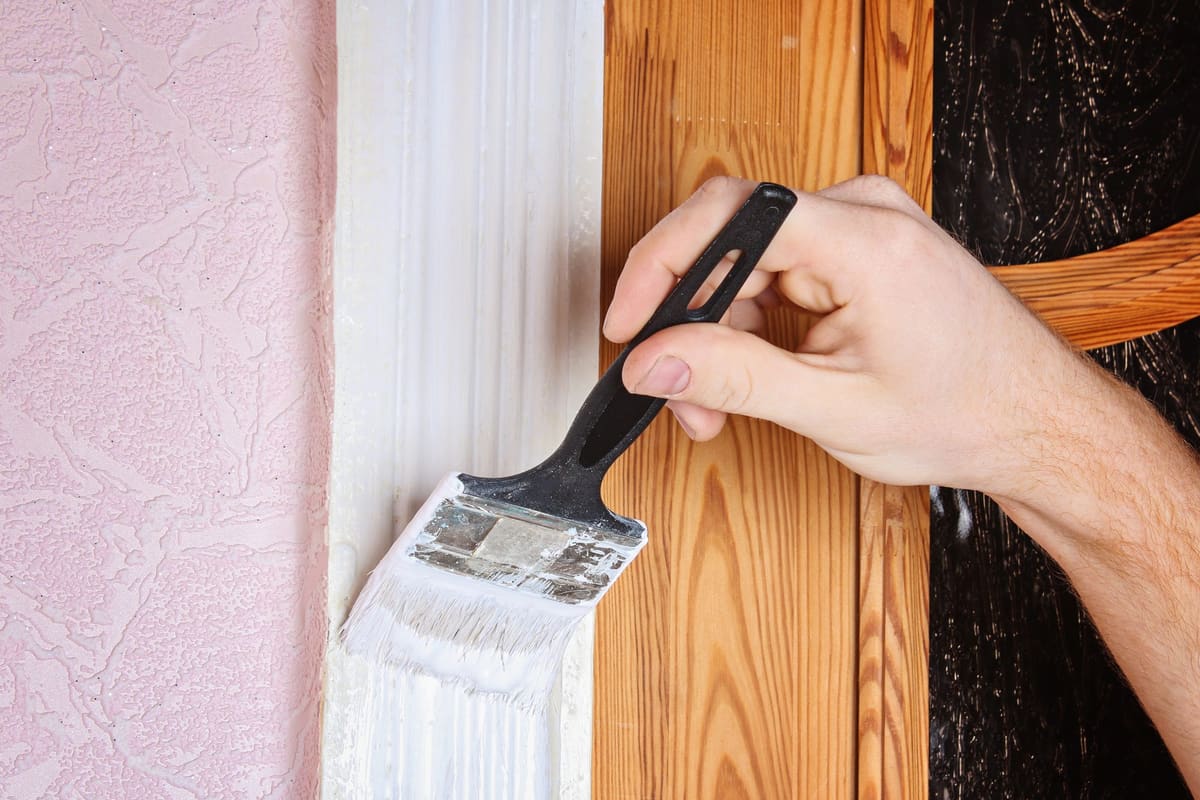
The third data sheet goes further. For wood that has already been painted, if the surface is enamelled, it says to remove the enamel with a stripper and paint it “as if it were a new, unpainted surface”. Two data sheets say sand and one says strip. It is not a contradiction to settle by eye: it is the reason for the test in the next section.
And varnish, which is what many interior doors have? None of the three data sheets names it. We treat it as what it is for them: a previous finish, which is sanded if it is sound and removed if it lifts.
The test that avoids surprises
When you do not know what is underneath, you test. One of the data sheets asks for it plainly: “It is recommended to carry out a test, applying the paint on a small area, to make sure there is no incompatibility between the two paint systems and the paints themselves (e.g. old solvent-based paint and new water-based paint, or vice versa)”. The other primer puts it in one line: “Check compatibility with the previous paint”.
On a door, the place for that test is a part that does not show, such as the top edge. If, once dry, it scratches off or lifts with a fingernail, the old finish is no good as a base.
The primer, when it is needed
On new or stripped wood, the enamel does not go straight on. The enamel’s data sheet asks for a primer first “to seal the pores”. One of the primer sheets gives another reason, particular to wood: it “prevents the black stains caused by tannins”.
And before priming, the wood has to be dry. One of the data sheets warns that too much moisture causes adhesion and colour defects, and sets the limit: the moisture content “must not exceed 12%-15%, depending on the type of wood”. It also asks for sanding and painting “in the same direction” as the grain.
The wait after the primer depends on what goes on top. The data sheet gives at least 4 hours before a water-based enamel and 24 before a solvent-based one.
The enamel, and how it goes on
The water-based enamel we have read is specifically recommended for doors, and its data sheet points out that it “does not yellow” and has no smell, which is welcome in a lived-in home. Its data sheet gives 30 minutes of drying and the second coat after 6 hours, at 23 °C. It covers, according to its data sheet, 11 to 14 m² per litre. What that figure means and why in practice it goes less far, in how much paint you need per m².
The most useful part of that data sheet is in the notes, and it is for doors: “On large, smooth surfaces (doors, cupboards, dados, etc.), for a perfect finish it is advisable to apply it with a short-pile wool roller leaving a generous coat, and immediately afterwards go over it with a dense foam roller (zero pore) with rounded edges to smooth out the small ridges”.
The two rollers
First, the short-pile roller, with a generous coat. It loads the door well, but leaves a slight texture in the film.
Straight away, the dense foam roller: the data sheet for a water-based enamel recommends it on doors and cupboards, with rounded edges, “to smooth out the small ridges”.
And the second coat, over the first once sanded: the data sheets for two primers ask for light sanding between coats.
The two primers agree on the rest: two finishing coats, sanding lightly between one and the next.
On the day you paint
The data sheets set limits on conditions. The enamel goes on between 10 and 35 °C. The primer asks you not to apply it with humidity above 80% and not to paint “in rainy weather or in the hottest hours”. On the coast it is worth checking the day before the tin: better a dry one, with the window open.
If the door is part of a bigger job, on the cost of painting a flat we explain why doors are counted per unit and not per metre. And if you would rather we did it, send us a photo of the door and of its top edge.
Frequently asked questions
Do you have to sand a door before painting it?
Do you have to sand a door before painting it?
Yes. If the old paint is well bonded, the data sheets we have read ask for it to be sanded to take the shine off, dusted and degreased before the enamel. If it is peeling or badly damaged, that is no longer enough: it has to come off and you start as on bare wood.
Can you paint a varnished door without removing the varnish?
Can you paint a varnished door without removing the varnish?
None of the data sheets we have read mentions varnish by name, so we are not going to give you a rule that is not written down. What they say for any previous finish in good condition is to sand it, and one of them adds a test on a small area to see whether the new paint and the old get on. If the test lifts, it comes off.
Can I put water-based enamel over an old solvent-based gloss?
Can I put water-based enamel over an old solvent-based gloss?
It is exactly the case one of the data sheets gives as an example: old solvent-based paint and new water-based paint. It recommends testing first on a small area. If it grips, go ahead; if not, a multi-surface primer or take the old finish off.
How long do you wait between coats?
How long do you wait between coats?
Whatever your enamel’s data sheet sets out. The water-based enamel we have read gives a drying time of 30 minutes and recoating after 6 hours, at 23 °C. If a primer goes on first, the one we have read asks for at least 4 hours before a water-based enamel and 24 before a solvent-based one.
Sources
- AkzoNobel, ficha técnica de Esmalte Acrylic Multisuperficie Satinado (version 11/23).
- Isaval, ficha técnica de Isalnox Imprimación Multiadherente Acqua (version 5, 4 May 2026).
- Cofan, ficha técnica de Imprimación Multiadherente al Agua (updated 11 June 2019).
Quotations from Spanish-language documents are our own translations.